Same crane, two ways to buy it. We break down the landed cost, the container maths and the fine print — with a real worked example — so you can choose with numbers instead of a guess.
What is a crane kit — and why leave out the biggest part?
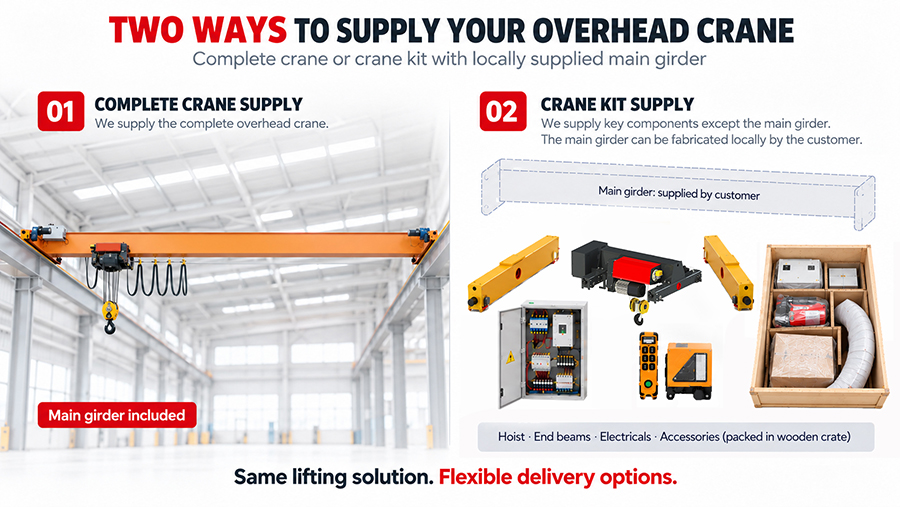
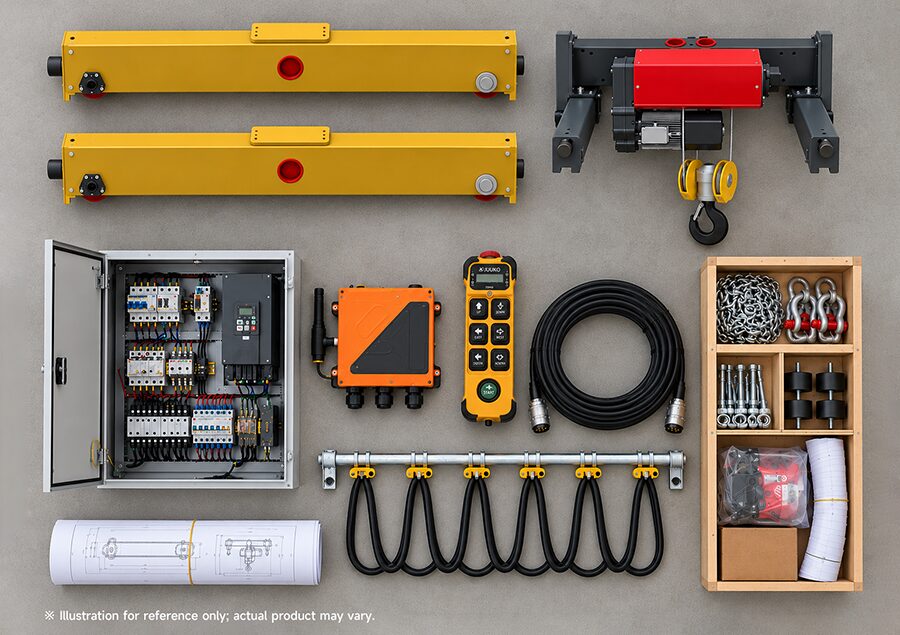
A crane kit is an overhead crane supplied without its main girder. You receive the end carriages, the hoist and trolley, the electrical system and controls, every bolt and bracket, and a complete fabrication drawing package; a steel fabricator in your country builds the girder to our drawings. A complete crane ships with the girder, fully assembled and load-tested at our factory.
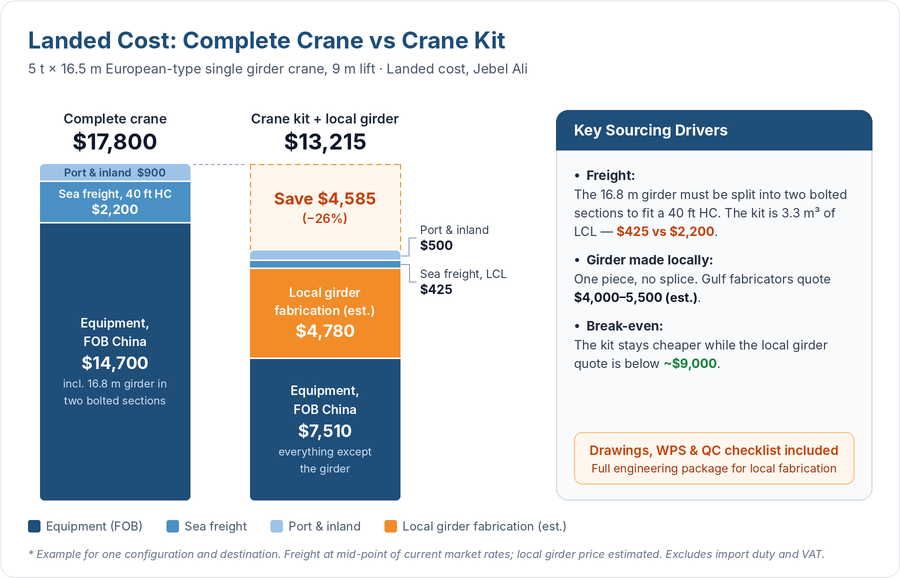
For a 5 t × 16.5 m European-type single girder crane delivered to the Gulf, the kit route lands about 26% cheaper in our worked example below — and anywhere from 10% to 30% depending on whether the kit ships as LCL or in its own container, and on what local fabrication costs. It can also cost you more where there is no capable fabricator, which is why this page shows both sides.
Why would anyone leave out the biggest part? Because the girder is the one component that is expensive to ship and simple to make. It is plain structural steel welded to a drawing, with no mechanical or electrical content. Everything that needs factory precision — wheels, gearboxes, hoist, inverters, controls — stays with us.
Why the girder decides your freight bill
Our 5 t × 16.5 m European-type single girder crane weighs 3.80 t. The girder alone is 2.76 t — nearly three-quarters of the crane's weight — and because it is one long, bulky piece it takes up about two-thirds of the packed shipping volume (6.6 m³ of 9.9 m³).
Length is the real problem. The girder for a 16.5 m span is 16.8 m long; a 40 ft high-cube container is 12.03 m inside. A one-piece girder therefore has two ways to travel: on a 40 ft flat rack as over-length cargo (about $8,000 ocean freight to Jebel Ali, plus special trucking and permits at both ends), or split into two bolted sections — our standard method. We cut the girder at one-third span (11.2 m + 5.6 m), add machined splice flanges and high-strength bolts, and the whole crane ships in one 40 ft high-cube at just 14% of its capacity. The splice costs some steel: the girder gains roughly 24% in weight.
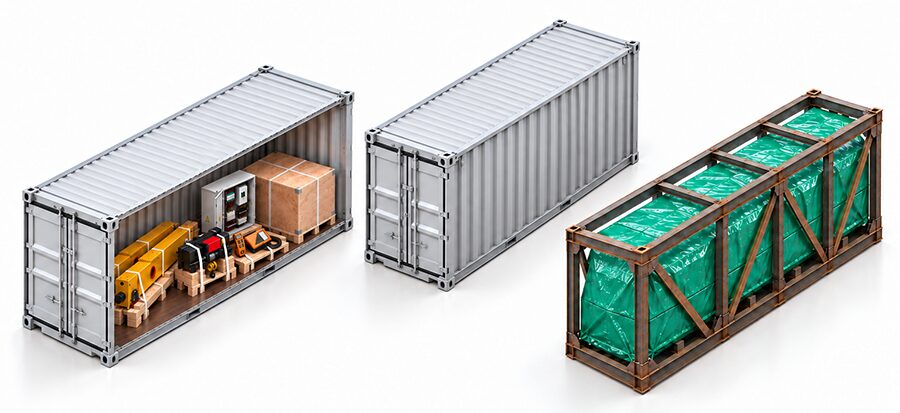
Remove the girder, and the entire remaining crane — end carriages, hoist, cabinet, cables, bolts — is three packages, 3.3 m³ and 1.1 t. It ships as LCL (less than container load) or fills 9% of a 20 ft container. No splice, no over-length, no flat rack.
Container
Internal length
What fits (5 t × 16.5 m example)
LCL / 20 ft GP
5.90 m
The complete crane kit: 3 packages, 3.3 m³, 1.1 t — billed as ~3.3 CBM LCL, or 9% of a 20 ft container
40 ft HC
12.03 m
The complete crane with the girder in two bolted sections (11.2 m + 5.6 m): 5 packages, 9.9 m³, 4.9 t — 14% of the container
40 ft flat rack
~12.0 m platform, over-length permitted
The complete crane with a one-piece 16.8 m girder, on request only — OOG surcharge, special trucking and permits at both ends
Landed cost, worked example
5 t × 16.5 m European-type single girder crane, 9 m lifting height, FOB China + sea freight to Jebel Ali. Prices are our current list for this configuration; freight is the mid-point of current market rates.
Complete crane (40 ft HC, two-section girder)
Crane kit (LCL)
Crane kit (20 ft GP)
Equipment, FOB China (incl. export port charges)
$14,700
$7,510
$8,630
Sea freight
$2,200 — 1 × 40 ft HC
$425 — LCL, 3.3 CBM
$1,400 — 1 × 20 ft GP
Port handling & inland delivery
$900
$500
$900
Local girder fabrication (plate, welding, paint)
—
$4,780 (Estimates are subject to actuals.)
$4,780 (Estimates are subject to actuals.)
Landed total
$17,800
$13,215
$15,710
Difference
$4,585 lower (−26%)
$2,090 lower (−12%)
Example figures for one configuration and one destination. Freight rates change monthly and local steel prices vary widely — send us your port and we'll run both options with live quotes.
Where the saving comes from. In the complete crane you pay about $5,900 for the girder — its steel, fabrication, paint and the extra 24% steel for the splice. A Gulf fabricator typically quotes $4,000–5,500 for the same girder in one piece, so the girder itself is already cheaper locally; the rest of the saving is freight: $425 of LCL instead of a 40 ft container.
When does the complete crane win? Run the numbers backwards: in this example the kit stays cheaper as long as your fabricator's quote for the girder is below about $9,000. Above that — or when there is no fabricator within reach who can weld box girders to specification, or when your schedule leaves no room to manage a second supplier — buy the complete crane.
If you insist on a one-piece girder: the same crane on a 40 ft flat rack lands at about $25,660 in Jebel Ali — $7,900 more than the two-section crane, and $13,000–20,000 more on African and South American routes. We only recommend it where a splice is not acceptable to your inspection body.
Everything except the girder, plus the drawing & QC package
Main girder
Fabricated, painted and tested at our factory; splice flanges machined and match-drilled
Fabricated locally from our drawings, in one piece — no splice; we review the fabricator's QC checklist before you assemble
Weight (5 t × 16.5 m)
Crane 3.80 t; girder 2.76 t one-piece, 3.42 t as two sections; 4.9 t packed
1.04 t net, 1.1 t packed
Factory testing
Full assembly; no-load, rated-load, 125% static and 110% dynamic load test before dispatch
Hoist load-tested on the test bench; end carriages run-tested; cabinet function-tested. Final load test on site after assembly, following our procedure
Shipping
1 × 40 ft HC, 5 packages, 9.9 m³ (14% of the container)
LCL, 3 packages, 3.3 m³ — or 1 × 20 ft GP (9%)
Freight to Jebel Ali
$2,200
$425 LCL / $1,400 20 ft GP
Lead time
25–30 days production + 25–45 days sea freight
20–25 days production, girder fabricated in parallel; same sea freight
Installation
Bolt the two girder sections together on the ground, lift onto the runway, connect power, test — 2–3 days
Bolt end carriages and hoist to the girder, fit festoon and wiring, lift onto runway, test — 3–5 days, remote-guided
Warranty
12 months on the whole crane
12 months on every part we supply; the girder is covered by your fabricator
Best for
No local fabrication; tight schedule; capacity above 20 t or span above 22.5 m; markets that certify the crane as one machine
Capable local fabricators; competitive local steel; 1–20 t, span up to 22.5 m, duty class A3–A5
What's in the crane kit
Hardware — everything except the girder (3 packages, 3.3 m³, 1.1 t for the 5 t × 16.5 m example)
Two end carriages with wheel blocks, travel motors and gear reducers, pre-assembled and run-tested
End-carriage connection drawing with bolt-hole positions and tolerances
Fabrication inspection checklist — camber, straightness, span tolerance, weld inspection, paint — your fabricator fills it in, we review it before you assemble
Assembly and installation manual with step-by-step video
Load test procedure and commissioning report template
A named engineer on video call from the drawing stage to the load test
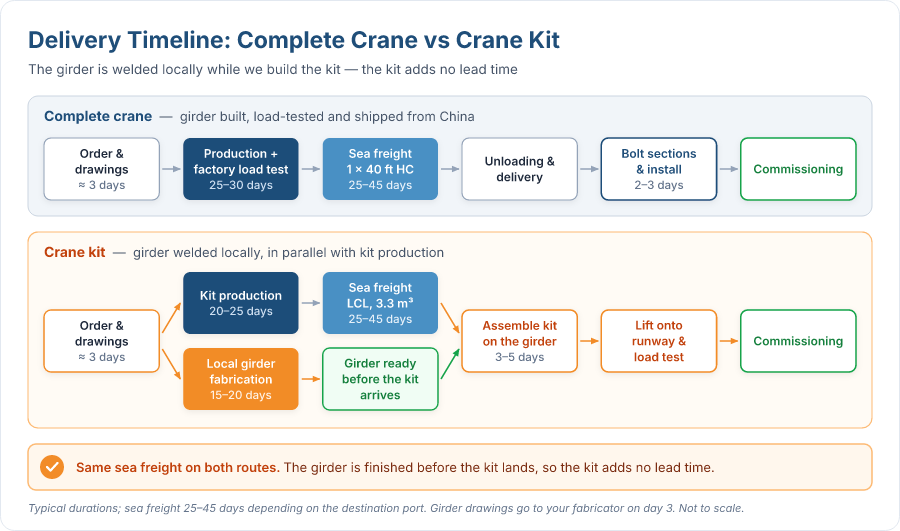
Delivery timeline: the girder is built while we build the rest
Complete crane: order and drawing approval (about 3 days) → production and factory load test (25–30 days) → 40 ft HC loading → sea freight (25–45 days) → unloading and delivery → bolt the girder sections together and install (2–3 days) → commissioning.
Crane kit: order and drawing approval (about 3 days) → girder drawings released to your fabricator on day 3 → in parallel: our production ( 20–25 days) and local girder fabrication ( 15–20 days) → LCL or 20 ft container → sea freight → kit assembled onto the girder on the ground (3–5 days) → lift onto runway → load test → commissioning.
Net effect: the kit adds no lead time as long as the girder is finished before the shipment arrives — with a 25-day voyage, it almost always is.
Which option fits your site? Three typical situations
Mining-region workshop, Peru → Complete crane. No box-girder fabricator within reach, plate steel is imported anyway, and the customer wanted one supplier responsible for the whole crane. Freight to the west coast of South America was a large share of the equipment cost — but still cheaper than two weeks spent finding and qualifying a fabricator.
Industrial zone, Saudi Arabia → Crane kit. The customer's steel contractor was already on site building the workshop. The one-piece girder was welded from local S355 plate for about $4,800, the whole kit arrived as a 3.3 m³ LCL shipment, and the landed cost came in about 26% lower than the complete crane.
New plant, Tanzania → Complete crane + on-site engineer. No local fabrication capacity and a fixed construction schedule. The crane shipped complete in one 40 ft HC; our engineer supervised the girder splice, the lift and the load test, and trained the operators before leaving.
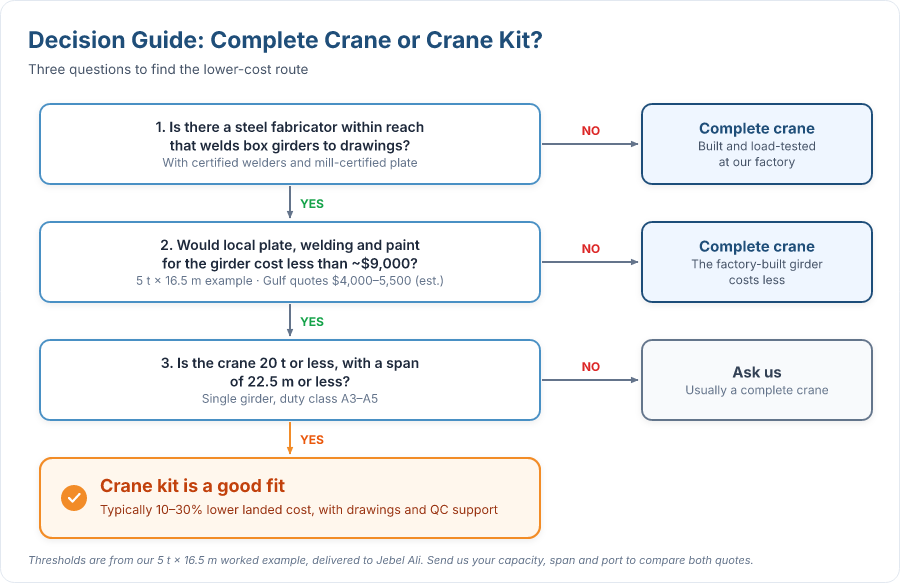
A three-question decision check
Is there a steel fabricator within reach that welds box girders to drawings, with certified welders and mill-certified plate? No → complete crane.
Would local plate, welding and paint for this girder cost less than about $9,000? (Gulf fabricators typically quote $4,000–5,500 for a 5 t × 16.5 m girder.) No → complete crane.
Is the crane 20 t or less, with a span of 22.5 m or less? Yes → crane kit is a good fit. No → ask us; large spans and double girder cranes usually belong in the complete-crane column.
What the locally fabricated girder must meet
A short version of the specification that ships with every kit:
Steel: Q235B or Q355B as stated on the drawing, or a certified equivalent (S235JR / S355JR, ASTM A36 / A572 Gr. 50); mill certificates required.
Welding: full-penetration butt welds on flange and web plates, staggered splices, welders qualified to ISO 9606 / AWS D1.1 or national equivalent, work carried out to our WPS.
Camber: upward camber of 0.9–1.4 ‰ of span measured at mid-span after welding — about 15–23 mm for a 16.5 m girder.
Straightness and tolerances: lateral bow ≤ S/2000; girder length and end-plate hole positions within ±3 mm of the connection drawing.
Stiffness: the drawing is designed for a static deflection of ≤ S/700 (S/800 for duty A4–A5) — do not change plate thicknesses without asking.
Inspection: 100% visual inspection; ultrasonic testing of flange butt welds; reports attached to our checklist.
Paint: blast-clean to Sa 2.5, primer plus topcoat to the specified dry-film thickness; hoist running flange masked.
Before assembly: send us the completed checklist with photos. We confirm, or flag corrections, before you lift the crane.
Frequently asked questions
Can I fabricate the girder myself?
Yes, if you have — or can hire — a steel fabricator that welds box girders to drawings with certified welders, mill-certified plate and basic NDT. We supply the drawings, the welding procedure and an inspection checklist, and we review the checklist before you assemble. If your fabricator has never built a crane girder, send us their profile and we'll tell you honestly whether to go ahead.
Does the warranty still apply on a crane kit?
Every part we supply carries our standard 12-month warranty, the same as on a complete crane. The locally fabricated girder is covered by your fabricator. Damage to our components caused by a girder that does not meet the drawing — wrong camber, flange out of tolerance, misaligned connection holes — is not covered, which is exactly why we review the fabrication checklist before you lift.
What steel grade should the girder use?
The drawing specifies Q235B or Q355B depending on span and capacity. Equivalent grades are acceptable with mill certificates: S235JR / S355JR (EN 10025), ASTM A36 / A572 Gr. 50, or the national equivalent. Don't substitute a different grade or thickness without asking — it changes deflection and camber.
How is camber controlled on a locally made girder?
The drawing specifies the camber (typically 0.9–1.4 ‰ of span, measured at mid-span after welding) and provides a cutting template for the web plates. The fabricator checks the camber with a string line or level after welding and records it on the checklist. A girder that comes out flat or sagging must be corrected before assembly — it would deflect beyond the limit under load.
How much does a crane kit cost compared with a complete crane?
For a 5 t × 16.5 m European-type single girder crane, the kit is $7,510 FOB against $14,700 for the complete crane — about half, because the girder and its splice are excluded and the kit ships as 3.3 m³ of LCL instead of a 40 ft container. After paying a local fabricator about $4,800 for the girder, the landed cost in our Gulf example is $13,215 against $17,800, or 26% lower. Shipping the kit in its own 20 ft container instead of LCL cuts the saving to about 12%, and in countries with expensive steel or no suitable fabricator the saving can disappear — ask us for both quotes.
What exactly is included in the kit?
Everything except the main girder: two end carriages with drives, the electric wire rope hoist and trolley, the electrical cabinet with inverters, festoon or conductor bar, wireless remote and pendant, limit switches, buffers, end stops, all connection plates and high-strength bolts — plus girder drawings, welding procedure, material list, inspection checklist, installation manual with videos, and video-call support. For the 5 t × 16.5 m example that is three packages, 3.3 m³ and 1.1 t.
How long does delivery take?
Drawing approval takes about 3 days and kit production 20–25 days; sea freight is 25–45 days depending on destination. Your fabricator receives the girder drawings on day 3 and typically needs 2–3 weeks, so the girder is ready before the shipment arrives and the kit adds no lead time.
How is a crane kit installed?
On the ground: bolt the end carriages to the girder with the supplied high-strength bolts, mount the hoist on the bottom flange, fit the festoon rail and wiring, and connect the cabinet. Then lift the assembled crane onto the runway with a mobile crane or two forklifts, connect power, and run the no-load and load tests from our procedure. Most customers finish in 3–5 days with our engineer on a video call.
How does a 16.8 m girder fit in a container at all?
It doesn't — not in one piece. Girders up to about 11.8 m fit a 40 ft high-cube; for longer spans we supply the girder in two bolted sections as standard (11.2 m + 5.6 m for a 16.5 m span), with machined splice flanges and high-strength bolts, so the complete crane still ships in one 40 ft HC. A one-piece girder is available on request and travels on a 40 ft flat rack as over-length cargo, at roughly $8,000 ocean freight to the Gulf and far more to Africa or South America.
Which cranes are suitable for the kit option?
Single girder cranes from 1 to 20 t with spans up to 22.5 m and duty class A3–A5 are ideal. For double girder cranes, capacities above 20 t, duty A6 and up, explosion-proof or outdoor cranes we recommend the complete crane: girder tolerances, trolley rails and testing requirements are harder to meet in a general fabrication shop.
Does the kit option affect CE marking or local certification?
In the EU, UK and some other markets the crane is certified as a whole machine. When the girder is fabricated locally, the company that assembles the crane generally takes on the obligations of the manufacturer of the complete machine. We supply the technical documentation for every component we deliver; confirm the requirements with your local inspection body before choosing the kit route.
Get both quotes — complete crane and kit — with live freight to your port
Tell us your capacity, span and destination port. Within 24 hours you receive a general arrangement drawing, wheel loads, and two priced options: the complete crane (with container type and freight) and the crane kit (with girder weight and plate list so your fabricator can quote).
Thank you for your interests in Kinocranes. Please feel free to submit your inquiry information to us. Our sales manager will contact with you as soon as possible.

 Customized Crane