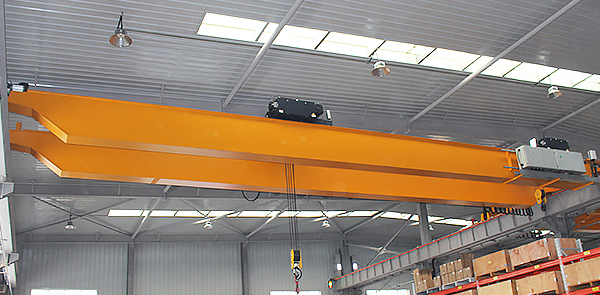
A metallurgical overhead crane is a bridge crane built for the steel mill — for lifting scrap, charging furnaces, carrying ladles of molten metal and moving hot slab and coil. It does the same job as a standard overhead crane, but everything around it is harder: radiant heat, molten metal below the hook, dust and scale, and near-continuous heavy-duty cycles. Those conditions change the crane's classification, its structure and a long list of safety features. This guide covers the main types of metallurgical crane and the special requirements that separate them from an ordinary bridge crane.
Metallurgical overhead cranes work over heat, dust and molten metal — conditions a standard bridge crane isn't built for.
The metallurgical crane family
"Metallurgical crane" is a family, not a single machine — each process step in steelmaking has a crane built for it.
Crane
Process step / job
Typical structure
Below the hook
Ladle crane
Pour molten iron/steel; feed refining furnace & casters
Double-girder/double-rail → four-girder/six-rail by tonnage
Ladle hook / trunnion
Charge crane
Load scrap or ore into the furnace
Floor-mounted (furnaces ≥150 t) or overhead
Charging box
Magnet crane
Move scrap, slab and billet
Double girder, electromagnet
Lifting magnet (on/off)
Coil / rolling-mill crane
Move hot & cold coil through the mill
Double girder
Coil tong / C-hook
Steel-yard gantry
Outdoor stockyard and laydown handling
Gantry on legs (rail-mounted / adjustable / portable)
Hook or magnet
Ladle crane
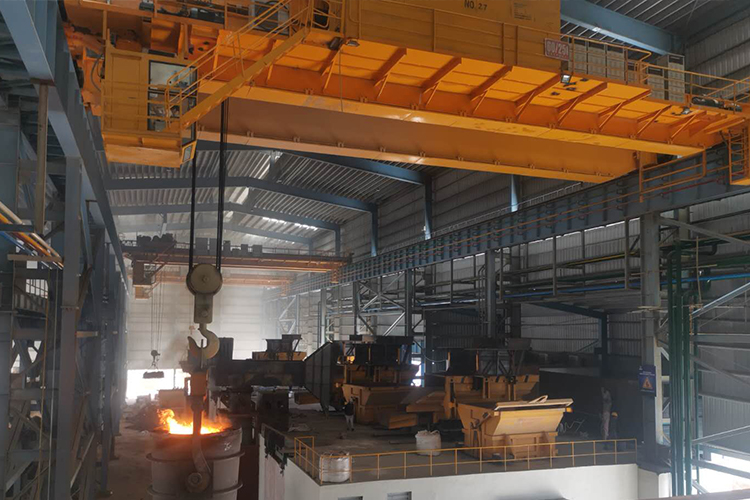
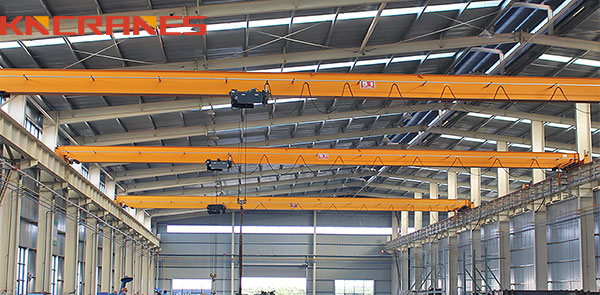
The critical machine of the melt shop. Ladle cranes pour liquid iron into the feeding bay and carry liquid steel to the refining furnace and casters. Because a spill is catastrophic, they are built with redundant structure and drives — typically a double-girder / double-rail, four-girder / four-rail or four-girder / six-rail arrangement, chosen by tonnage — so the load path survives a single failure. See the ladle handling crane and heavy-tonnage four-girder ladle crane.
Two-girder ladle handling crane — redundant structure keeps the load path safe over molten metal.
Charge crane
Loads scrap or ore into the furnace. Charge cranes are floor-mounted or overhead depending on furnace size: floor-mounted units serve large shops with furnaces of 150 tons or more, while overhead charge cranes handle medium-sized furnaces. They are engineered for heavy, repetitive loads and hard duty.
Magnet (scrap and slab) crane
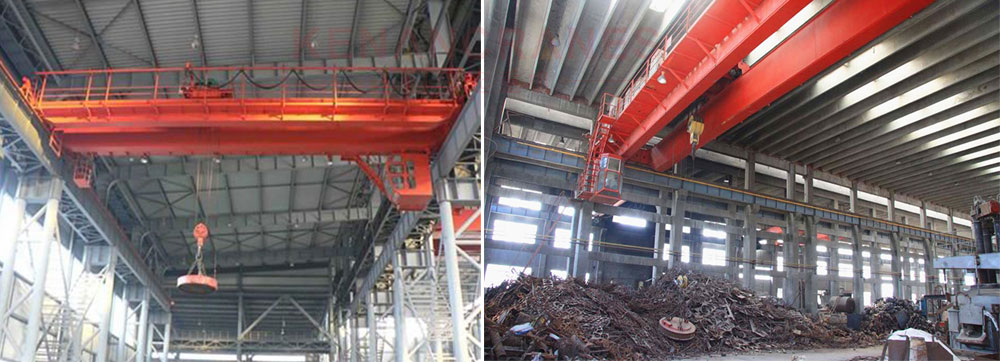
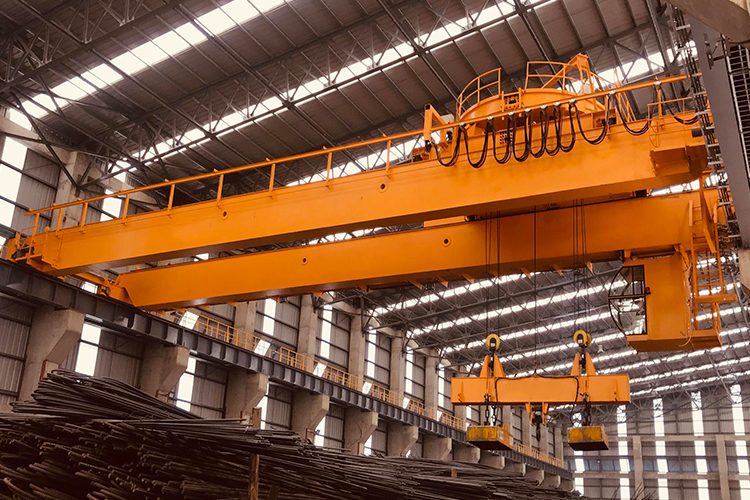
An electromagnetic crane whose magnet switches on and off to pick up and release ferrous material — steel and iron scrap in the scrap yard, and slab or billet on the handling line. See slab and billet electromagnetic cranes.
Rotating-trolley magnet crane — the switchable electromagnet handles scrap, slab and billet.
Coil and rolling-mill crane
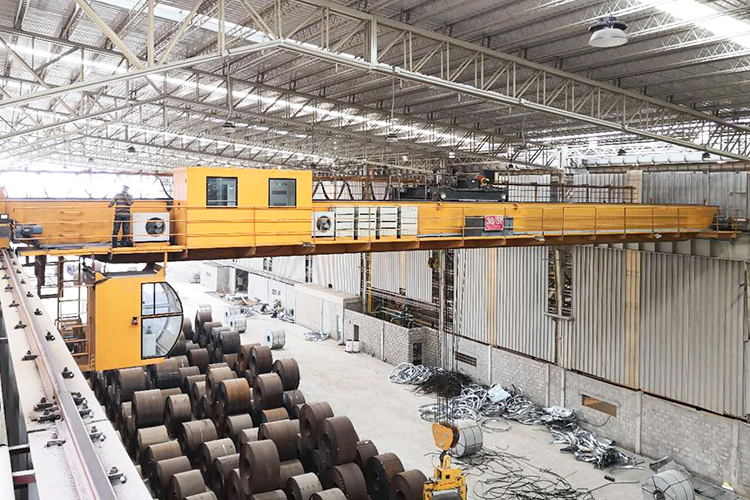
Downstream of casting, coil handling cranes move hot and cold coil through the rolling mill, usually with a coil tong or C-hook below the hook. See the rolling-mill overhead crane.
Coil handling crane — moves hot and cold coil through the mill with a tong or C-hook.
Gantry cranes for the steel yard
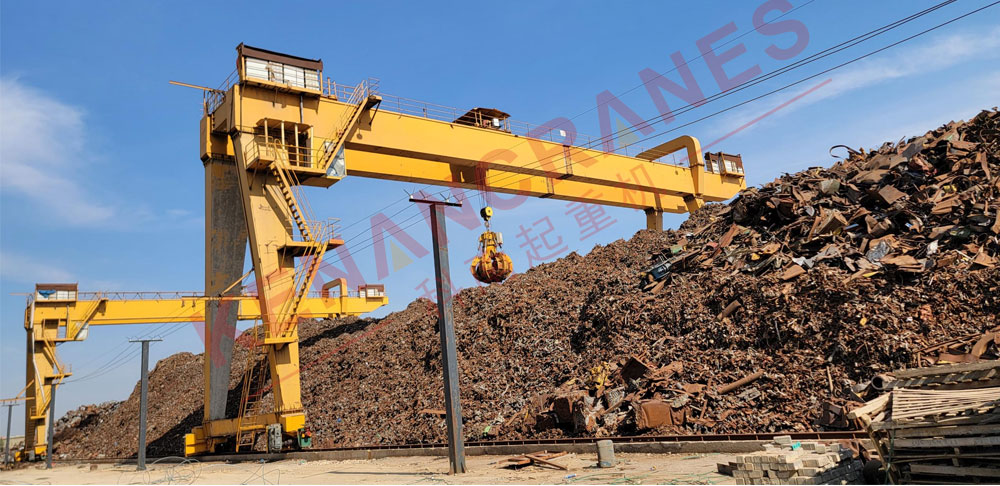
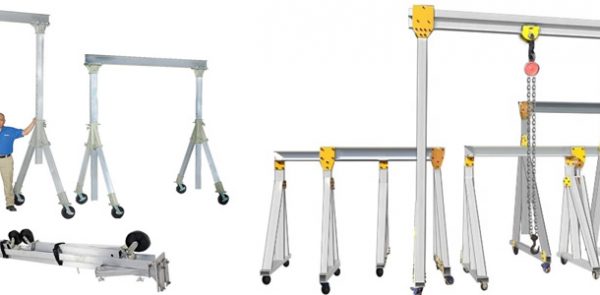
For outdoor work — stockyards and laydown areas where an overhead runway isn't available or the building can't carry crane loads — a gantry crane on its own legs is used. Steel-yard gantries come in adjustable, portable and rail-mounted forms.
Gantry crane for the outdoor steel yard — runs on its own legs where no runway is available.
Why metallurgical cranes are classified harder
Metallurgical work is among the most demanding duty a crane sees: long hours, frequent lifts, and loads at or near capacity. That puts these cranes in the upper duty classes (broadly A6–A8 / heavy to extra-heavy), which sizes the structure, mechanisms and components well above a general workshop crane. Hot-metal cranes carry extra safety margins again, because the consequence of a failure is molten metal. If you're unsure what class your process needs, our guide to crane working-class selection explains how it's set — and it's set by real usage, never by capacity alone.
The special requirements that set them apart
Because of the heat, molten metal and continuous duty, metallurgical overhead cranes carry specific requirements that a standard bridge crane does not. These are the key ones:
Heat-rated electrical equipment. Motors and controls must suit the environment. Where ambient temperature exceeds 40 °C, use H-class insulation motors (or equivalent measures), and provide reliable thermal insulation and cooling for the electrical control devices.
High-temperature, flame-retardant cables. Cabling routed on a metallurgical crane must be heat-resistant and flame-retardant.
Enclosed, cooled operator cabin. Cab-operated cranes need an enclosed cabin with cooling fans and flame-retardant insulation layers for a safe, workable environment.
Anti-radiation heat shielding. Anti-heat-radiation devices are fitted beneath the main girder's lower cover — except when the load is a container with its own top cover.
Overspeed protection. The hoisting mechanism carries overspeed protection to guard against a dropped or overloaded lift caused by malfunction.
Purpose-built hoisting motors. Hoist motors are specified for lifting and metallurgical duty, not general-purpose, for the performance and safety the job demands.
Redundant braking. Where the hoist uses contactor-controlled braking, a single contactor fault or contact welding must not cause loss of control — so dual braking systems are used. Heat also calls for heat-resistant wire rope on hot-metal duty; see what type of wire rope is used on a crane.
How to spec a metallurgical crane
Start from the process step and the metal state — scrap, charge, molten ladle, hot slab or coil — because that sets the crane type, the attachment and the safety features before any capacity number. Then confirm the bay geometry, the duty cycle and the thermal environment. Kino Cranes designs custom metallurgical cranes for the full melt-shop-to-rolling-mill chain, built and tested to the heavy-duty and safety standards the steel industry requires; the metallurgical wire-rope hoist is one of the hot-duty components behind them. For the full picture of how these cranes fit a plant, see our steel industry crane solutions.
Talk to an engineer
Tell us the process step, the tonnage and the environment, and our engineers return a configuration and budget price within 24 hours. WhatsApp +86 190 3730 3917 or email [email protected].
Thank you for your interests in Kinocranes. Please feel free to submit your inquiry information to us. Our sales manager will contact with you as soon as possible.

 Customized Crane