A 20 ton overhead crane is a bridge crane rated to lift 20,000 kg, and a 16 ton crane lifts 16,000 kg; at this size the main design decision is whether one girder is still enough or two are needed. Typical spans run from 10.5 m to 34.5 m, and FOB China prices run from $25,000 to $62,000 depending on girder type, span and duty class.
The short answer: a single girder crane still works at 16 – 20 t for shorter spans and light to medium duty, while a double girder becomes the default once the span passes about 16.5 m, the duty class reaches A5 or above, or you need every metre of hook height. The rest of this guide shows where that line sits and what it means for your runway and budget.
Single girder (LD or European-type) on shorter spans; double girder (QD or European-type)
Single girder up to about 16.5 m span; double girder (QD or European-type) beyond that
Span
Single girder up to 16.5 m; double girder 10.5 – 34.5 m
10.5 – 34.5 m, European-type double girder
Lifting height
Typically 6 – 12 m; higher on request
Typically 6 – 12 m; higher on request
Duty class
A3 – A5 single girder; A5 – A6 double girder; A7 with a winch trolley
Same
Hoist / trolley
European-type wire rope hoist; open winch trolley on QD double girder
European-type wire rope hoist; open winch trolley on QD double girder
Lifting speed
About 5 m/min main speed with a creep speed; VFD for stepless control
Same
Crane travel speed
Up to 0 – 40 m/min with VFD
Up to 0 – 40 m/min with VFD
Power supply
380 – 415 V, 50 / 60 Hz, 3-phase, to your site standard
Same
Runway rail
Sized to suit the wheel load — specified on the GA drawing with your quote
P22 up to 16.5 m span; P30 from 19.5 m (European-type double girder)
Max wheel load, 16.5 m span
Calculated for your span and capacity — shown on the GA drawing
66.9 kN per wheel on 8 wheels (European-type double girder)
Crane weight, 16.5 m span
Calculated for your span and capacity — shown on the GA drawing
9.45 t, including a 1.07 t trolley (European-type double girder)
The 20 ton figures come from our European-type double girder spec sheet. A crane at this size usually runs on eight wheels, two per corner, so the load per wheel stays moderate. We issue exact figures with the general arrangement drawing for your span and lifting height.
Single girder or double girder at 16 – 20 t?
At 5 – 10 t a single girder is the obvious choice for most workshops. At 16 – 20 t it is a real decision, and the right answer depends on span, duty and hook height more than on capacity alone. For a general comparison across all sizes, see choosing between single and double girder cranes.
A single girder crane still makes sense when:
The span is short, up to about 16.5 m
Duty is A3 – A5: a few heavy lifts per hour rather than continuous production
The building is new and you want the lightest runway and the lowest crane price
Hook height is not critical — the hoist hangs below the girder
A double girder crane is the better choice when:
The span is beyond about 16.5 m — a single girder would need a very deep, heavy box section to stay within deflection limits
Duty is A5 – A6 or higher, or the crane runs two or three shifts
You need the maximum hook height — the trolley runs on top of the girders and the hook rises between them
You want an auxiliary hook (for example 20/5 t), a maintenance walkway, or a cabin
Heavier loads are likely later — size the girders and runway for the final capacity now, because a new trolley cannot raise the rating of a girder designed for less
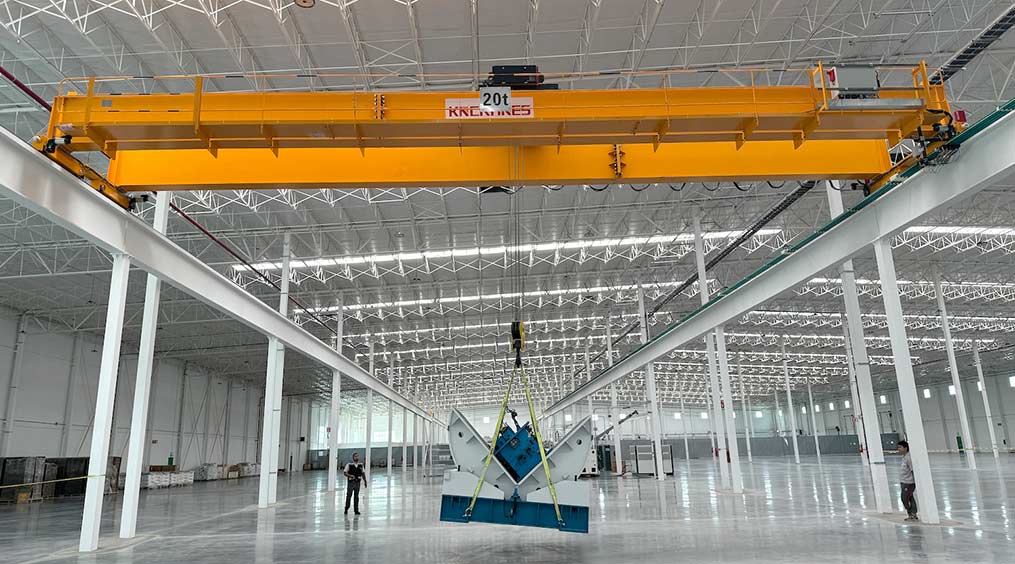
Double girder does not have to mean heavy. Our European-type double girder crane at 20 t and 16.5 m span weighs 9.45 t in total, with a 1.07 t hoist trolley.
European-type or Chinese standard (QD)?
European-type double girder
QD double girder
Trolley
Compact wire rope hoist trolley
Open winch trolley — drum, gearbox and brake on the trolley frame
Weight and wheel loads
Lighter girder and trolley, lower wheel loads
Heavier; higher wheel loads
Headroom
Low-headroom trolley, more hook height in a low building
Taller trolley, needs more roof clearance
Duty
A5 – A8 typical
A5 – A7; suits continuous heavy duty
Price
Higher
Lower
European-type cranes are the better fit for new buildings, where lighter wheel loads save runway steel. QD cranes with an open winch trolley suit steel plants and continuous heavy duty, where the mechanism is easy to reach and maintain. See our QD double girder overhead crane and, for lighter duty, the European-type single girder range up to 20 t and the LD single girder crane.
Duty class matters as much as capacity at this size. If you are unsure whether your process is A5 or A6, our guide to crane hoist duty classification explains how lifts per hour and average load decide it.
Runway rail and wheel load: what to check before you order
A 16 – 20 t crane puts real load into the building. Before you request a quote, confirm these points:
Wheel load and runway beams. Our 20 t European-type double girder crane has a maximum wheel load of 66.9 kN at 16.5 m span, rising to 81.3 kN at 28.5 m. Give these figures to your structural engineer before the runway beams and columns are designed.
Rail size. P22 is enough up to 16.5 m span on a 20 t European-type double girder crane; from 19.5 m it moves to P30. For QD cranes and 16 t configurations we confirm the rail on the drawing.
Upgrading from 10 t. If you are replacing a 10 t crane with a 16 – 20 t crane, check the runway first. A runway and building designed for a 10 t crane are rarely good for 20 t without reinforcement.
Span and clearances. Span is measured from rail centre to rail centre. Allow at least 200 mm from the top of the trolley to the roof structure, and check lights, ducts and sprinkler pipes along the runway.
Power. Confirm the supply voltage and frequency, the total connected load from our drawing, and the length of the conductor bar or festoon.
If the girders and runway are sound, a new crane is not always the answer. For a steel plant in Kenya we first supplied a single 16 t hoist trolley package as a trial unit, installed by the plant's own team with remote guidance; two years later the customer ordered the upgrade of four double girder cranes to A7 duty.
20 t single girder LD or European-type, span up to 16.5 m
$23,000 – $29,000
16 t double girder QD, span 16.5 – 22.5 m
$26,000 – $35,000
20 t double girder QD, span 16.5 – 22.5 m
$30,000 – $41,000
20 t European-type double girder, 16.5 m span
$34,000 – $39,000
20 t European-type double girder, 22.5 – 28.5 m span
$40,000 – $58,000
Prices exclude runway rails, installation and freight. The step from 16 t to 20 t in the same configuration usually adds 15% - 25% (approx. 4,000–7,000 USD). More capacities are covered on our overhead crane price page.
What moves the price:
Span. Girder weight and steel cost grow quickly with span at this capacity — compare the 20 t spec sheet: 9.45 t of crane at 16.5 m, 20.16 t at 28.5 m.
Duty class. A6 – A7 needs a heavier mechanism, larger wheels and a stronger structure than A5.
Trolley type. A European-type hoist trolley, an open winch trolley, or an imported hoist.
Extra equipment. Auxiliary hook, maintenance walkway, cabin, VFD on all motions, radio remote, load display.
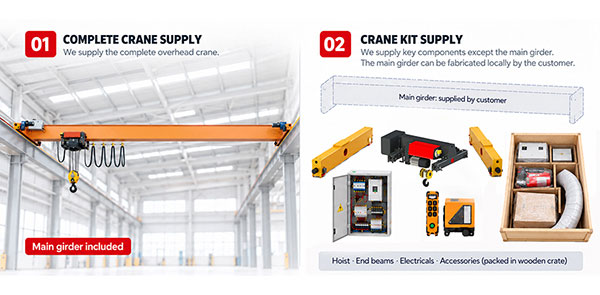
Shipping configuration. Main girders built in bolted sections fit standard containers and cut freight — the approach we used for the 20 t crane in Mexico. For the economics of shipping a full crane against fabricating the girder locally, see complete overhead crane vs crane kit.
Typical applications
Automotive components — two 10 t and one 20 t double girder cranes in Mexico, European modular design with main girders in sections for container shipping, and variable frequency drives for precise positioning.
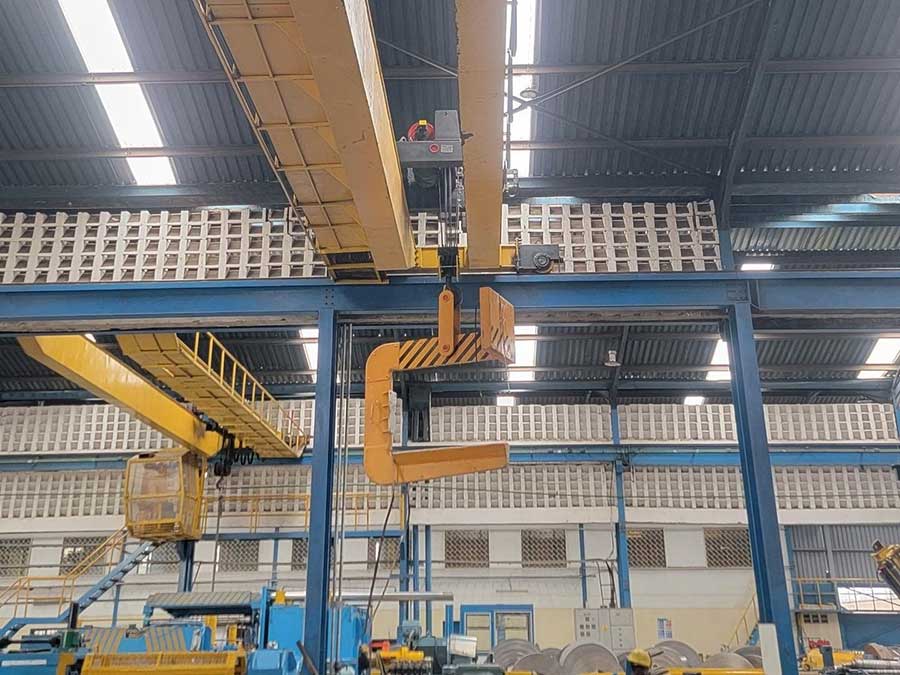
Steel processing, continuous duty — the Kenya modernization programme, which began with a 16 t hoist trolley and moved four cranes to A7 duty.
Fabrication and precast — 16 – 20 t double girder cranes for steel structures, tanks and precast elements, often with an auxiliary hook for turning loads.
Capacity: 16 t / 20 t (include slings, spreader or other attachments)
Auxiliary hook needed? ___ t
Span, rail centre to rail centre: ___ m
Lifting height, floor to hook: ___ m
Runway length: ___ m; new building or existing runway (designed for ___ t)?
Duty: lifts per hour ___ / shifts per day ___ / average load ___ t
Maintenance walkway or cabin: yes / no
Indoor or outdoor; ambient temperature ___ °C
Power supply: ___ V / ___ Hz
Destination port: ___
FAQ
How much does a 20 ton overhead crane cost?
A 20 ton overhead crane costs $ 34,000 to $ 62,000 FOB China, depending mainly on girder type, span and duty class. Add runway rail, freight and installation for the landed cost.
Can a 20 ton overhead crane be single girder?
Yes, on shorter spans — up to about 16.5 m — and light to medium duty. Beyond that span, at A5 duty and above, or where hook height matters, a double girder is the safer choice.
What is the wheel load of a 20 ton overhead crane?
Our 20 t European-type double girder crane has a maximum wheel load of 66.9 kN per wheel at 16.5 m span, on eight wheels, rising to 81.3 kN at 28.5 m. Exact values depend on span, trolley and duty and are shown on the drawing.
What rail does a 20 ton overhead crane need?
For our European-type double girder crane, P22 up to 16.5 m span and P30 from 19.5 m. QD cranes with a winch trolley usually need a heavier rail, confirmed on the drawing.
Should I choose 16 ton or 20 ton?
Size for your heaviest load including attachments, then look ahead. If loads are close to 16 t or likely to grow, a 20 t crane costs around 15% – 20% more and saves rebuilding the runway later.
Get a drawing and quote in 24 hours
Send us your span, lifting height and duty cycle — we return a drawing and quote within 24 hours. The general arrangement drawing includes the wheel loads your runway designer needs.
Thank you for your interests in Kinocranes. Please feel free to submit your inquiry information to us. Our sales manager will contact with you as soon as possible.

 Customized Crane