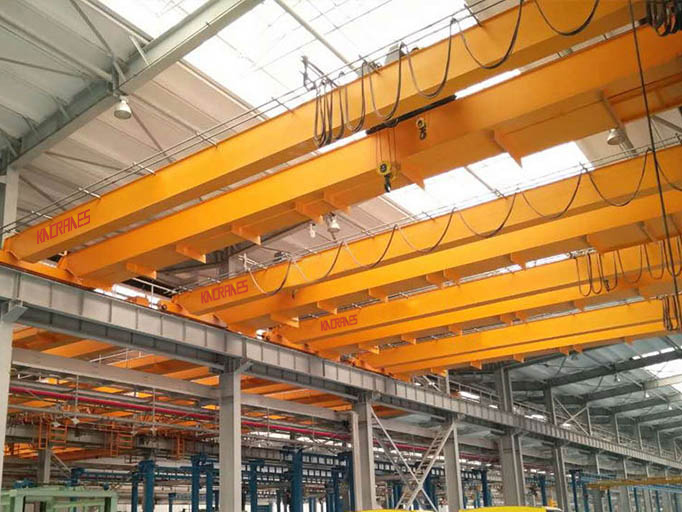
A steel processing plant in Kenya had four double girder overhead cranes that were still structurally sound but mechanically worn out. The main girders were fine. The runways were fine. The hoist trolleys were not.
The customer set the boundary in their first email, before anything had been quoted: replace the hoisting machinery and the travel drives, and leave everything else alone. This case study is about what it takes to work inside that boundary — and why, on a site with no OEM service network within reach, the decisive engineering question turned out to be whether the plant’s own maintenance team could carry out the changeover themselves.
4Cranes retrofitted
A7 / M7Duty classification
10 tMax capacity in scope
1050–1400 mmCross travel rail gauges
6 mLifting height
0.5–5 m/minVFD hoisting speed
Project Background and Requirements
The plant processes hot rolled coil and runs several tube mill lines. Cranes there work around the clock, lifting for roughly 60% of each day, with loads regularly reaching 90% of rated capacity, on a site handling 7,000 to 10,000 tonnes of coil a month. That is not a workshop duty cycle. It is continuous heavy service, and it is why the customer specified A7 (equivalent to ISO M7) rather than a general purpose classification.
Four cranes were in scope, serving the tube mill bays and one adjacent production bay. Three constraints shaped everything that followed.
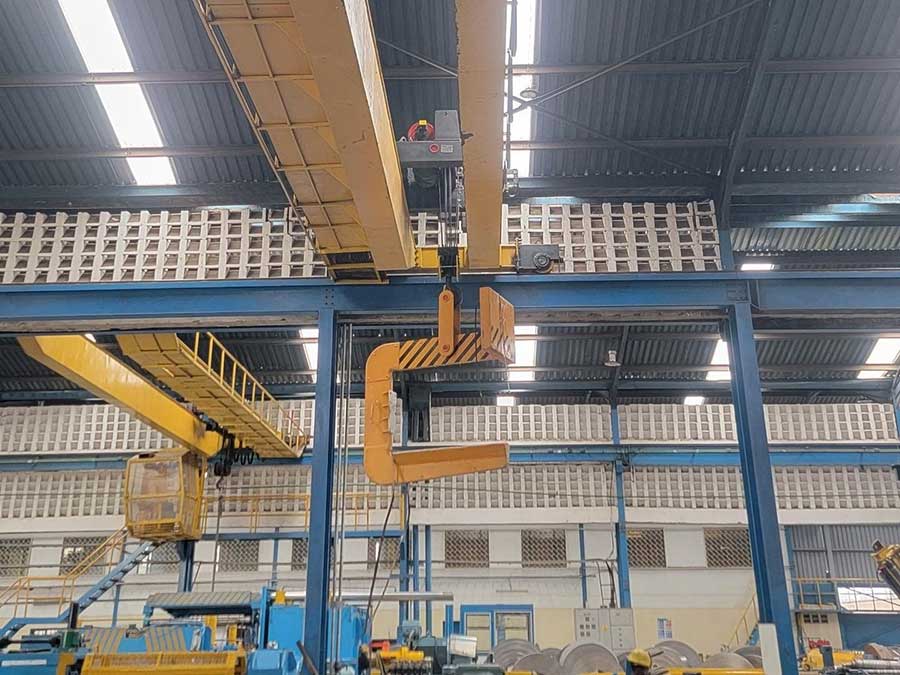
The structures still had years of life in them. Replacing complete cranes would have meant scrapping main girders and end carriages that were in good condition. On a retrofit, the structure is the asset you are trying to keep.
The shutdown window was short. On a line moving that tonnage, lost production costs far more than the equipment does. Every hour a crane is out of service has to be justified against output.
There is no OEM service presence nearby. Any solution that depended on foreign engineers flying in and staying for a multi-week installation would be uncontrollable on both schedule and cost — and would overrun the shutdown window regardless of how good the machinery was.
The constraint that set the design
The customer did not ask for better cranes. They asked for the worn parts of four working cranes to be replaced without touching the girders, the runways or the building — and to be able to do the work with their own people.
Technical Specifications
Project Type
Crane modernization — hoist trolley and travel drive replacement
Crane Type
Double girder overhead cranes, existing, retained in place
Quantity
4 cranes, delivered in two phases
Rated Capacity
10 t (three cranes), 7 t (one crane)
Span
13.00 m / 13.08 m / 15.18 m / 15.18 m
Cross Travel Rail Gauge
1050 mm / 1400 mm / 1400 mm / 1400 mm
Lifting Height
6 m
Duty Classification
A7 (FEM/DIN), equivalent to ISO M7
Hoisting Mechanism
Winch type hoist trolley — rope drum, gearbox and brake on the trolley frame
Hoisting Speed
0.5–5 m/min, variable frequency, 10:1 range
Control
Radio remote control with pendant backup
Operating Regime
24-hour continuous, approx. 60% lifting time, load factor to 90%
Supply Scope
Hoist trolley assembly, electrical control panel, wheel blocks or end carriage, long travel drive, radio remote
Excluded from Scope
Main girders, runway rails, building structure — all retained
Installation
Carried out by the customer’s own maintenance team, with remote technical guidance
Wiring
Pre-made looms with aviation plug connectors — negligible field wiring
Application
Steel coil processing and tube mill material handling
Location
Kenya, East Africa
The four cranes have two different cross travel rail gauges — 1050 and 1400 mm — and four different spans. There was no single trolley design copied four times. Each one was built to the rail gauge of the specific crane it had to sit down on. This is the part of a retrofit that is most often underestimated at quotation stage.
Key Engineering Decisions
01Selected on the load spectrum, not the nameplate
A7 / ISO M7 with 24-hour operation and load factors reaching 90% places the hoisting mechanism near the top of its service classification. Rope, drum, gearbox and brake were sized against that spectrum. Standard duty components would carry the rated load without difficulty and still reach the end of their life years early — which on this site would mean repeating the whole exercise.
02Same mechanism type, deliberately
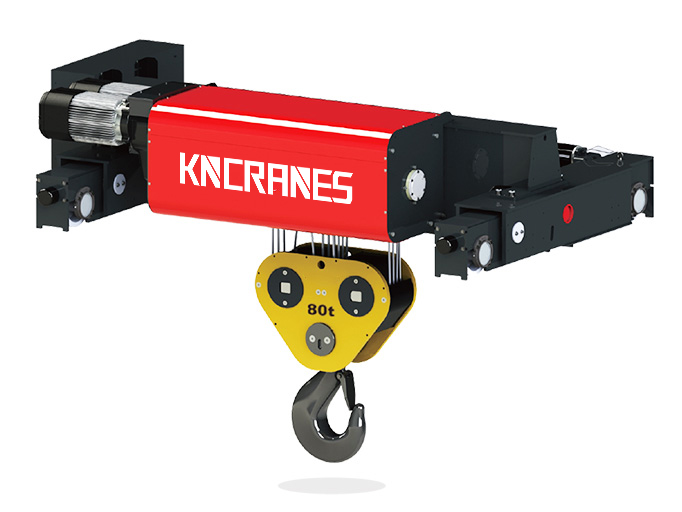
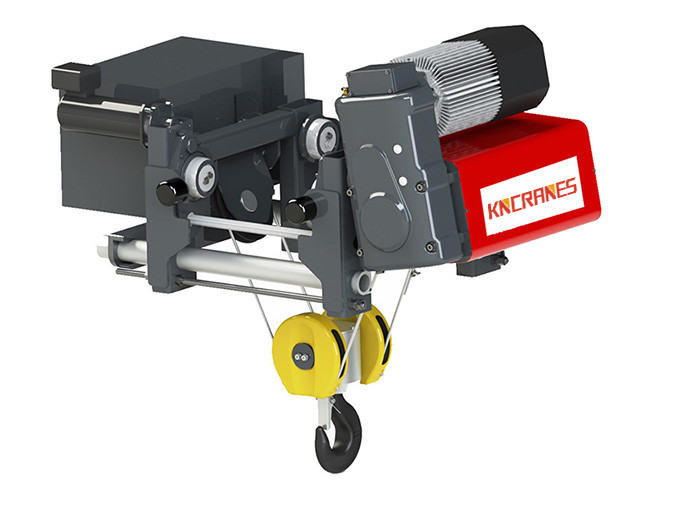
The original units were winch type hoist trolleys, with drum, gearbox and brake mounted on the trolley frame. The replacements keep that architecture. This was not conservatism. Keeping the mechanism type is what makes the interface with the existing cross travel rails and girders identical, and a direct changeover possible. A retrofit that changes the machine type turns into a structural project.
03Variable frequency hoisting, 10:1
Hoisting speed 0.5 to 5 m/min under VFD control. The top speed protects cycle time on a line that cannot afford to slow down; the creep speed is what lets an operator set a load down accurately. On the old machinery a single fixed speed had to serve both duties.
04Radio remote control
The operator can stand where the load is actually visible, rather than working from a cab position fixed decades ago when the bay was laid out differently. On coil and bundle handling this matters more for safety than for productivity.
05Pre-wired with aviation plug connectors
Every loom between trolley, control panel, travel drives and remote receiver was made up and tested before shipping. On site the connections plug together. Almost no field wiring is the single decision that governs how long the crane stays out of service — and it was the shutdown window, not the machinery, that was the binding constraint here.
06Wiring diagrams written for the plant’s electricians
Clear drawings and unambiguous wire numbering, so the plant can trace a fault on its own three years from now. On a site without OEM support within reach, documentation quality is part of the machine, not an accessory to it.
Installation by the Customer’s Own Team
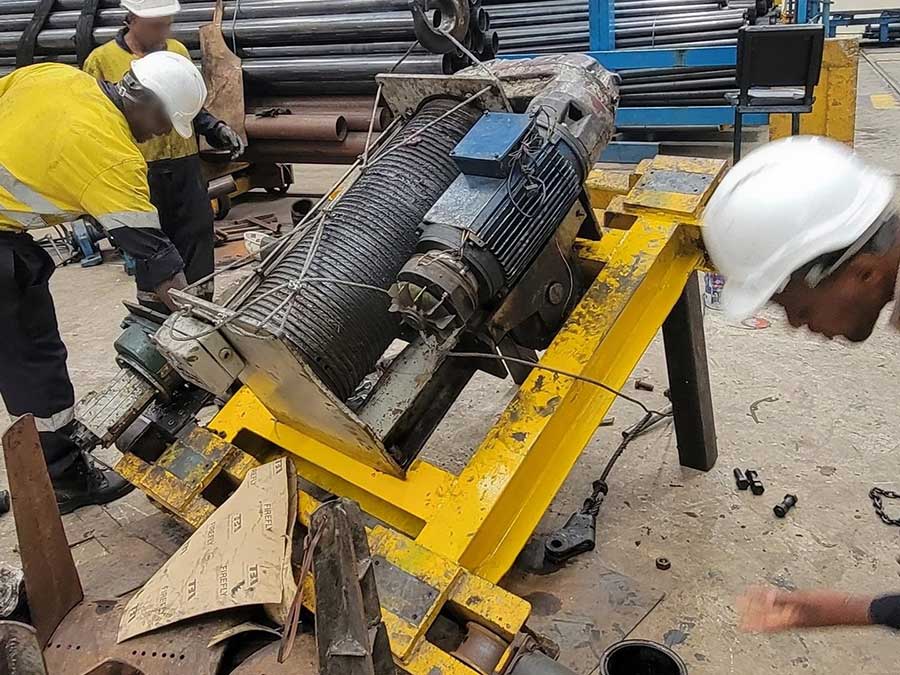
The changeover was carried out entirely by the plant’s maintenance crew, with remote technical guidance from our engineers. No engineers were deployed to site. Per crane the sequence was: lift off the old hoist trolley, lift the new one into place on the existing cross travel rails, connect the plugs, energise and test.
The customer’s own description of the package was that it was easy to handle.
That is worth stating plainly, because it is the part most often glossed over in retrofit proposals. Whether a modernization project succeeds on a site like this depends less on how good the new machinery is than on whether the people who already work in the building can install it. If the answer is no, both the schedule and the cost belong to someone else.
How the Specification Was Established
The first enquiry gave us three capacities, a lifting height and a duty class. That is nowhere near enough to engineer a retrofit, so the questions we asked back were about the application rather than the product.
What we asked
What it determined
What is lifted, and in which bay
Lifting attachment and bay allocation
Hours per day and load factor
Confirmed A7 / ISO M7, not standard duty
Monthly tonnage and unit weight
Confirmed high cycle, heavy service
Cross travel rail gauge, crane by crane
Trolley frame width — different on almost every crane
Photographs and drawings of the existing cranes
As-built interface verification before manufacture
This is the structural difference between a new crane and a retrofit. A new crane is built to a specification. A retrofit is built to the interfaces of equipment that is already hanging in the building, and every question left unasked is a risk that the new trolley will not sit down on the rails.
From first enquiry to order took around seven months. Verifying as-built dimensions crane by crane, and scheduling shutdown windows around a continuous production line, is not a process that compresses.
Quality Assurance
Each hoist trolley built to the measured cross travel rail gauge of its specific crane, checked against customer-supplied drawings and photographs before manufacture
Hoisting mechanism selected against the A7 / ISO M7 load spectrum rather than the nominal load
All inter-component wiring made up and continuity tested before shipment
Complete supply per crane — trolley, control panel, wheel blocks or end carriage, travel drive and radio remote — so that nothing has to be sourced locally at the last minute
Remote technical guidance through removal, installation and commissioning
When a Hoist Trolley Replacement Is Not the Right Answer
Retrofitting is not automatically the cheaper option, and we would rather say so before quoting than after.
If the main girders show fatigue cracking, significant section loss to corrosion or permanent deflection, replacing the hoisting machinery buys you a new mechanism on a structure that is closer to the end of its life than the mechanism was. If the required capacity has increased since the crane was installed, the girder was never designed for the new load and no trolley change fixes that. And if the runway itself is worn or out of alignment, that has to be dealt with first — a new trolley on a bad runway wears out early, and it will look like a supplier problem.
The honest test is whether the structure is genuinely sound. Where it is, replacing the hoist trolley is usually better economics by a wide margin. Where it is not, it is money spent twice.
Results
2022 — a single 16 t hoist trolley package supplied as a trial unit, installed and proven in service by the customer
2024 — the four-crane programme ordered and executed in two phases
Installation carried out by the plant’s own maintenance team with remote guidance; no engineers deployed to site
Continued component supply since the retrofit, including hoisting inverters and radio remote controls — the cranes remain in service under routine maintenance
2026 — two complete European style double girder overhead cranes ordered
The progression is the result worth reporting. One trial unit earned the four-crane programme. Four working cranes earned an order for new machines.
Why Choose Kinocranes for Crane Modernization
Retrofit packages built to the as-built interfaces of your existing cranes, not to a catalogue frame size
Pre-wired with aviation plug connectors, so most customers complete the changeover with their own maintenance team
Remote technical guidance through removal, installation and commissioning
Documentation written so that your electricians can maintain the equipment without us
A straight answer on whether your crane is worth retrofitting — including when it is not
Is your crane a candidate for a hoist trolley replacement?
If the girders and runways are still in good condition but the hoisting machinery has reached the end of its service life, replacing the trolley alone is usually the better option. Send us the following and our engineering team will come back with a feasibility view, a configuration and a budget figure:
Rated capacity, span and lifting height
Cross travel rail gauge, measured on site
Duty class, running hours per day and load factor
Photographs or drawings of the existing crane
Available shutdown window
Whether you have a maintenance team who could do the changeover