Plain-language articles from our engineers — crane types, components, safety and maintenance. All published on this site; organized and searchable so you can actually find them.
The wire rope is the only component between your load and gravity, and it is a consumable — every crane is re-roped several times in its life. This guide covers what crane wire rope actually is, the requirements specific to cranes, exactly when a rope must be scrapped, and the rules for replacing one.e only component between your load and gravity, and it is a consumable — every crane is re-roped several times in its life. This guide covers what crane wire rope actually is, the requirements specific to cranes, exactly when a rope must be scrapped, and the rules for replacing one.
Types, construction and uses of steel wire rope
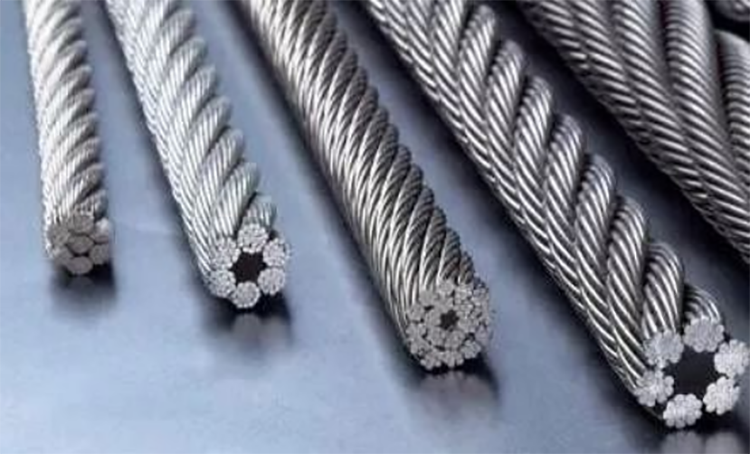
The type, construction, raw material and manufacturing process of a wire rope all depend on its application. General-purpose steel wire ropes are made from carbon-steel wires of 0.1 to 6.0 mm diameter with a circular section. When twisting sealed and semi-sealed ropes, Z-shaped and other special-shaped wires are used. To increase safety and reliability, ropes are also made with coated steel wires, stainless-steel wires and bimetallic steel wires.
Ropes are classified by purpose: suspension-bridge ropes, mine ropes, aerial-cableway ropes, traction ropes for transmission devices, elevator ropes, and ropes for bundling and dragging goods, among others — and the range keeps growing as constructions become more complex. Whatever the type, a crane rope must have sufficient strength, good flexibility, a compact and even lay, and resistance to wear and crushing. The exact construction and diameter for your crane are stated on its GA drawing and spare-parts list; order against that, using the crane number from the nameplate.
Three requirements specific to crane ropes
1. Rotation-resistant (left–right) lay
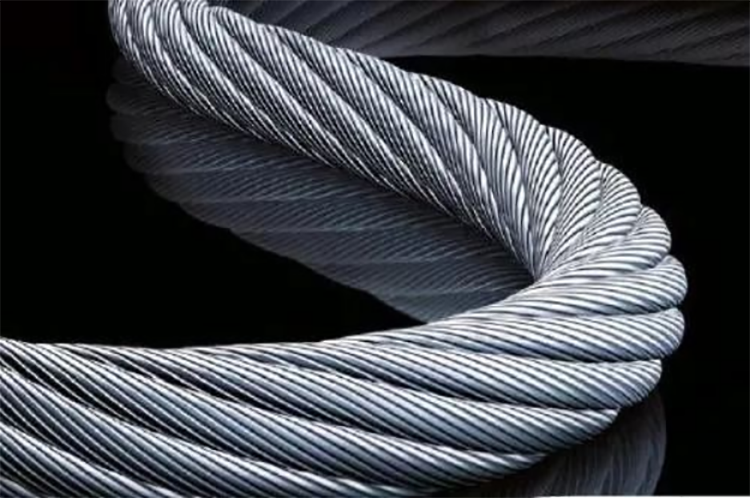
Crane hoisting ropes use a left–right (regular / lang's combination) lay so that a freely suspended load does not spin and the rope does not loosen under load. Every rope must be supplied with its quality certificate.
2. Heat-resistant rope for hot metal
Ropes lifting or transporting hot or molten metal must use a heat-resistant rope (fire-resistant core) instead of a standard fibre-core rope, which dries, chars and collapses. This is standard practice on our metallurgical cranes.
3. No joints in hoisting and luffing
The hoisting and luffing mechanisms must run a continuous rope with no joints. Where a connection is unavoidable elsewhere, its strength must be at least 90% of the rope's breaking force, and it must not pass over a sheave or onto the drum.
When should a crane wire rope be scrapped?
Scrap the rope when it meets any one of the following conditions:
#
Scrap condition
Limit
①
Broken wires within one lay (twist) pitch
> 10% of the total number of wires
②
Outer steel-wire wear
> 40% of the original wire diameter (if less, scrap by broken-wire count after dismantling)
③
Ropes lifting hot metal or dangerous goods
Broken wires reach half the count allowed for general lifting ropes — surface corrosion of the wires counts toward this reduction
④
Rope diameter reduction
Reduced by 7% of nominal
⑤
Structural failure
A whole strand broken, fibre core exposed, or outer wires standing out in a cage-like or hard-knot state
Match the replacement to the original specification. If a rope of different diameter must be used, the difference from the original should not exceed 1 mm when the original diameter is 20 mm or less, or 1.5 mm when the original is over 20 mm. A rope that is too thick rubs against itself as it winds onto the drum and wears faster. When replacing or spooling, never let the rope kink — practice proves a kinked rope is the most likely to wear through and break in service. Connecting two steel wire ropes together in a hoisting mechanism is forbidden.
If the drum, hoist or trolley is as worn as the rope, re-roping alone is a false economy — see crane modernization & retrofit.
Ordering a replacement rope
Send the crane number from the nameplate (or a photo of the old rope's tag) to [email protected] — matched replacement ropes are a stock item and ship fast. Our ropes carry various characteristics suited to heavy lifting and demanding service; more on rope care and selection: wire rope solutions: expert workshop advice.
Thank you for your interests in Kinocranes. Please feel free to submit your inquiry information to us. Our sales manager will contact with you as soon as possible.

 Customized Crane