1
Resources · Crane 101

Crane Knowledge Library

Plain-language articles from our engineers — crane types, components, safety and maintenance. All published on this site; organized and searchable so you can actually find them.

How To Install Crane Track Rail Clamps

Rail clamps are what keep a crane's rail exactly where the wheels expect it. Installed right, they hold gauge for years and let you fine-adjust alignment without cutting welds; installed wrong, they're the hidden cause behind rail gnawing and premature wheel wear. Here's the WJK-type installation procedure in full.

WJK-type crane rail clamp installation overview.

1. Select the clamp model for your rail

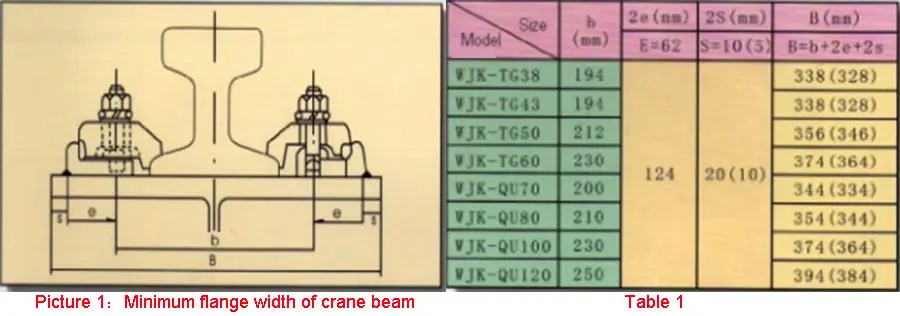
WJK clamps are matched to the rail section: TG38–TG60 series for lighter flat-bottom rails, QU70–QU120 series for heavy crane rails. Two dimensions govern fit: the runway girder's top flange must meet the minimum width (the "b" value) for the base plate, and the T-bolt center sits 97–125 mm from rail center (the "a" value) depending on model.

Rail ModelCrane Rail Climps ModelRail ModelCrane Rail Climps Model
TG38WJK-TG38QU70WJK-QU70
TG43WJK-TG43QU80WJK-QU80
TG50WJK-TG50QU100WJK-QU100
TG60WJK-TG60QU120WJK-QU120
minimum top-flange width (value b) the crane girder needs for the clamp base plate
Crane Rail Climps Modela(mm)
WJK-TG3897
WJK-TG4397
WJK-TG50106
WJK-TG60115
WJK-QU70100
WJK-QU80105
WJK-QU100115
WJK-QU120125

2. Weld the base plates

  • Spacing along the rail: one base plate every 600 mm (standard duty) or 500 mm (heavy duty)
  • Weld pattern: two-sided welds for medium-duty cranes; three-sided surround welds for heavy and extra-heavy duty
  • Electrode matched to base material: E4315 for Q235-class steel, E5015 for Q345-class steel [VERIFY with engineering]
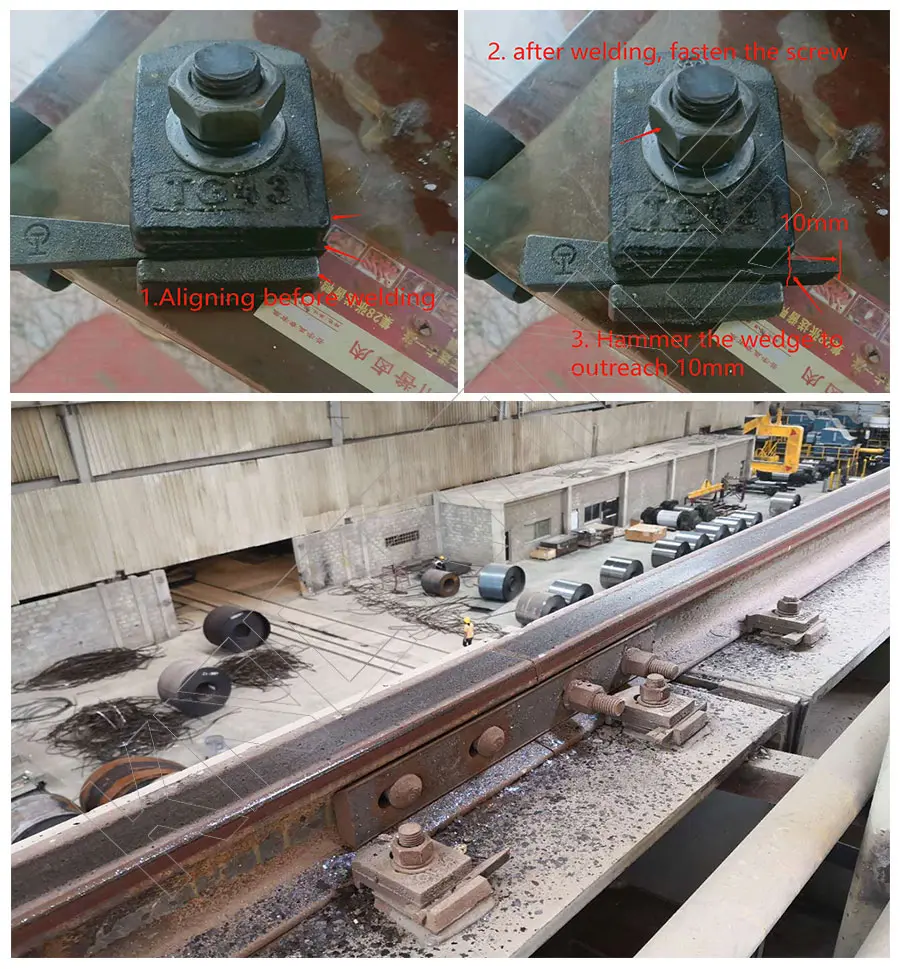
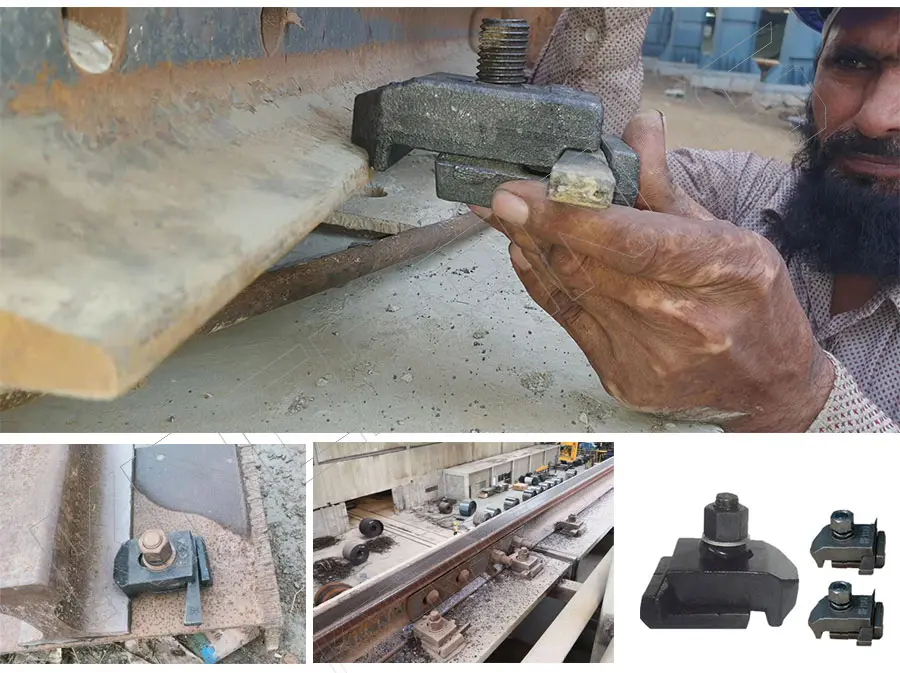
WJK clamps fixing the crane rail to the runway girder

3. Assemble in this exact order

  1. Place the T-bolt in the base plate
  2. Add the adjustment plate and upper cover plate
  3. Fit the flat washer
  4. Add the spring washer
  5. Thread the nut and tighten the T-bolt
  6. Adjust the rail gauge (the clamp's slotted adjustment is exactly for this)
  7. Final-tighten to torque

Tighten until the spring washer shows a 2 mm height difference at its joint — that's the compression indicator.

4. Torque and capacity by clamp material

Clamp bodyBolt gradeTightening torqueMax lateral force per wheel
ZG270-500 (cast steel)Grade C150 N·m45 kN
ZG16Mn (cast alloy)Grade 8.8220 N·m55 kN

The lateral force your wheels actually produce comes from the crane's design data — if you're building a new runway, run the wheel load calculator and pass the results to your structural engineer.

5. Check alignment before the crane goes up

Gauge, straightness and rail level decide how smoothly the crane runs and how long wheels last. After clamping, verify gauge at every clamp position and re-check after the first weeks of operation — clamped systems allow correction without hot work, which is exactly why they beat welded-only rail fixings for maintainability.

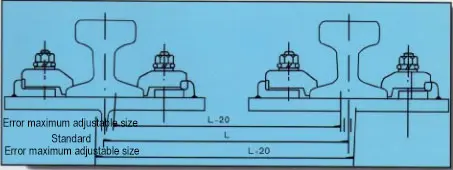
Maximum adjustable gauge range of the WJK clamp — the slotted plate corrects rail-centreline deviation without re-welding.

If worn wheels or end carriages are behind the gnawing rather than the rail, those renew without a new crane — see wheels & end-truck retrofit.

Questions mid-installation? Send photos to WhatsApp +86 190 3730 3917 — our engineers answer installation questions within 24 hours, and video-call support is available for tricky alignment.

Leave Message

Thank you for your interests in Kinocranes. Please feel free to submit your inquiry information to us. Our sales manager will contact with you as soon as possible.

Learned enough to spec your crane?

Send your requirements — our engineers turn them into a configuration and budget price within 24 hours.

TO TOP

+8619037303917

[email protected]

0086-373-5968887

GIFA & METEC Indonesia 2026 Cranes | Booth 7407