Plain-language articles from our engineers — crane types, components, safety and maintenance. All published on this site; organized and searchable so you can actually find them.
Warehouse overhead crane lifts and moves heavy loads through a storage or fulfilment building — freeing floor space, cutting forklift trips and letting a small crew move loads a forklift can't reach safely. But "warehouse crane" isn't one machine: a light assembly bay, a high-throughput dispatch aisle and an outdoor laydown yard each want a different configuration. This guide covers the types that fit a warehouse, what each is best at, and how to choose.
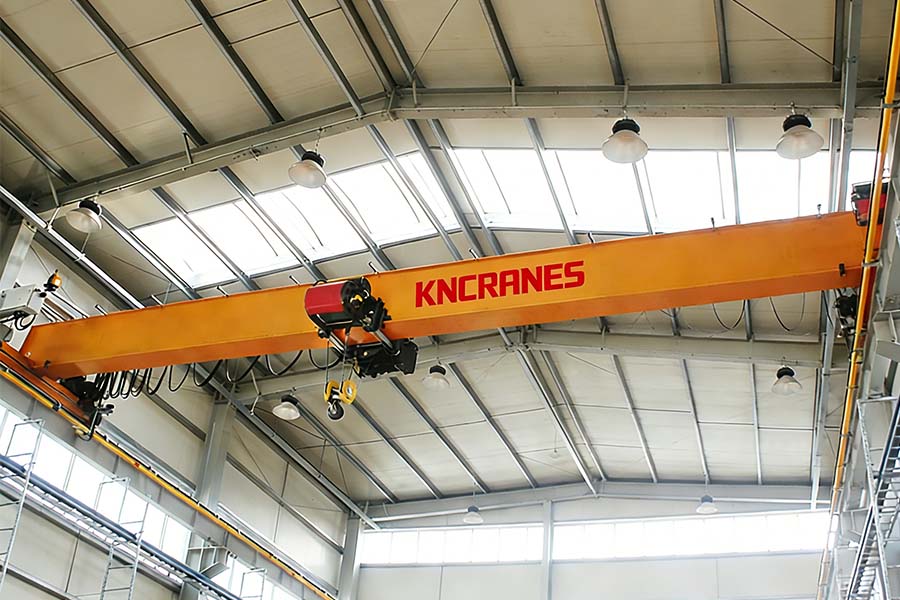
An overhead crane keeps the warehouse floor clear — the load travels overhead instead of through the aisles.
Which crane for which warehouse job
The right choice is set by weight, how often you lift, and whether you need to cover a whole bay or just one workstation.
Type
Best for
Typical capacity
Why it fits
Single-girder bridge crane
General warehouse lifting, light-to-medium duty
1–20 t
Most economical full-bay coverage; low headroom loss
Double-girder bridge crane
Heavier loads, wide spans, higher hook
20 t and up
More capacity and lifting height when a single girder isn't enough
Cheapest way to serve a single station or aisle corner
Semi-gantry / gantry
Outdoor yard, or a bay where the structure can't take a runway
1 t and up
Carries its own legs — no building runway needed
The main types, in detail
Bridge (overhead) cranes — single and double girder
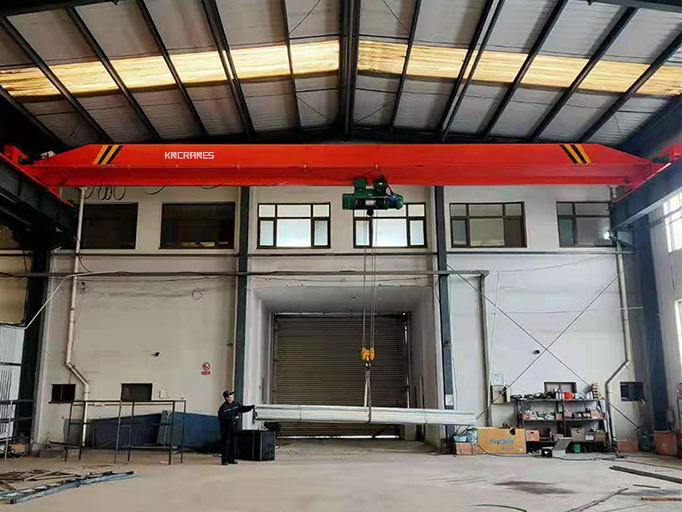
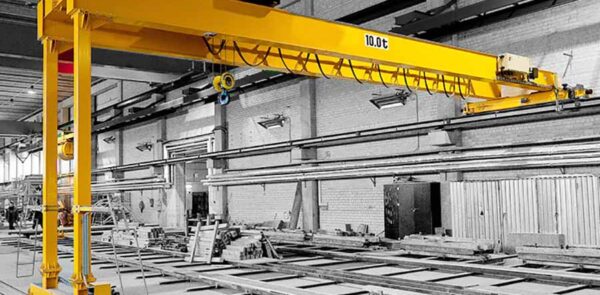
The workhorse of the warehouse. A bridge runs on runway beams along the building, the trolley crosses the bridge, and the hoist lifts — so the whole floor under the runway is served with nothing in the aisles. A single-girder overhead crane covers most warehouse duty economically (roughly to the 20-tonne range); a double-girder overhead crane is for heavier loads, wider spans and greater hook height. The full trade-off is in single vs double girder.
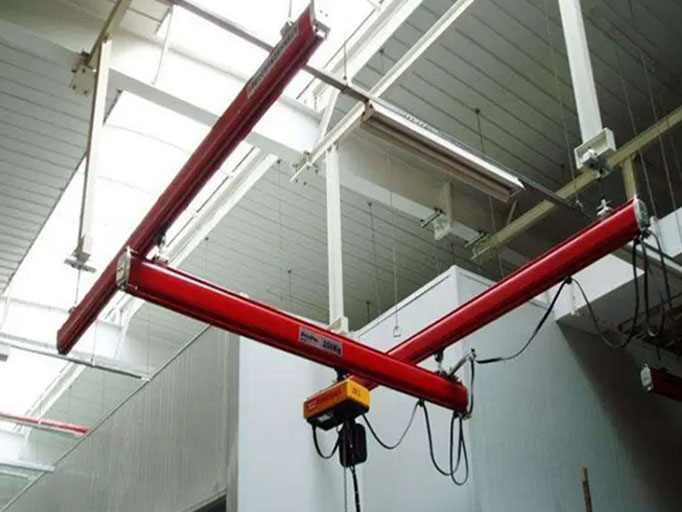
For repetitive handling at an assembly cell, packing line or machine, a light workstation crane on a light track moves easily by hand and can be laid out to match the work area — a lighter, lower-cost answer than a full bridge crane when loads are modest.
Light workstation (KBK) crane — modular track for one-hand handling at a cell or line.
Jib cranes
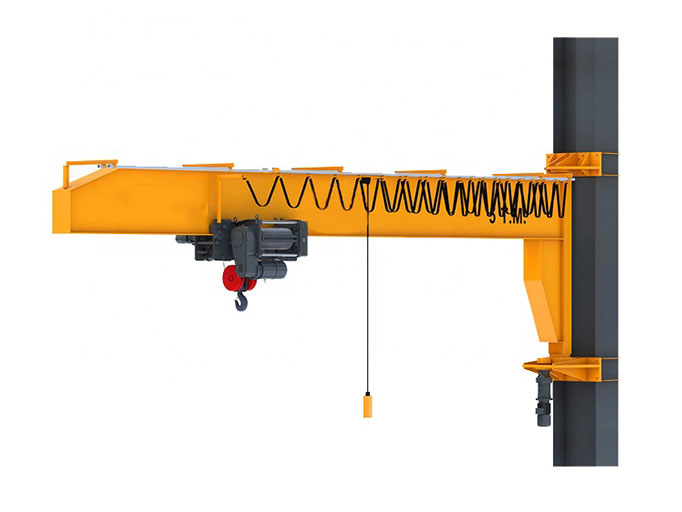
A jib crane serves a circle around a single post or wall bracket — the cheapest way to cover one workstation, a loading door or an aisle corner. Often used alongside a bridge crane: the bridge covers the bay, jibs handle the spots.
Wall-mounted jib crane — spot coverage of a single station without taking a full bridge crane.
Gantry and semi-gantry cranes
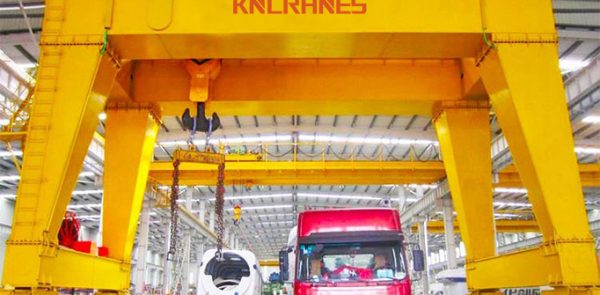
Where there's no usable building structure — an outdoor laydown yard, or a bay whose columns can't carry a runway — a gantry crane brings its own legs. A semi-gantry (one leg on the floor, one end on an existing wall runway) is a money-saver when one side already has structure.
Why warehouses use overhead cranes
Three things a forklift can't match: the load travels overhead, so aisles and floor stay clear for racking and traffic; a single operator moves heavy or awkward loads safely, cutting manual-handling injuries; and once installed it lifts fast and repeatably, raising throughput without adding headcount. In most warehouses a crane and forklifts work together — the crane for the heavy and repetitive lifts, forklifts for the rest.
How to choose one for your warehouse
Five things set the configuration:
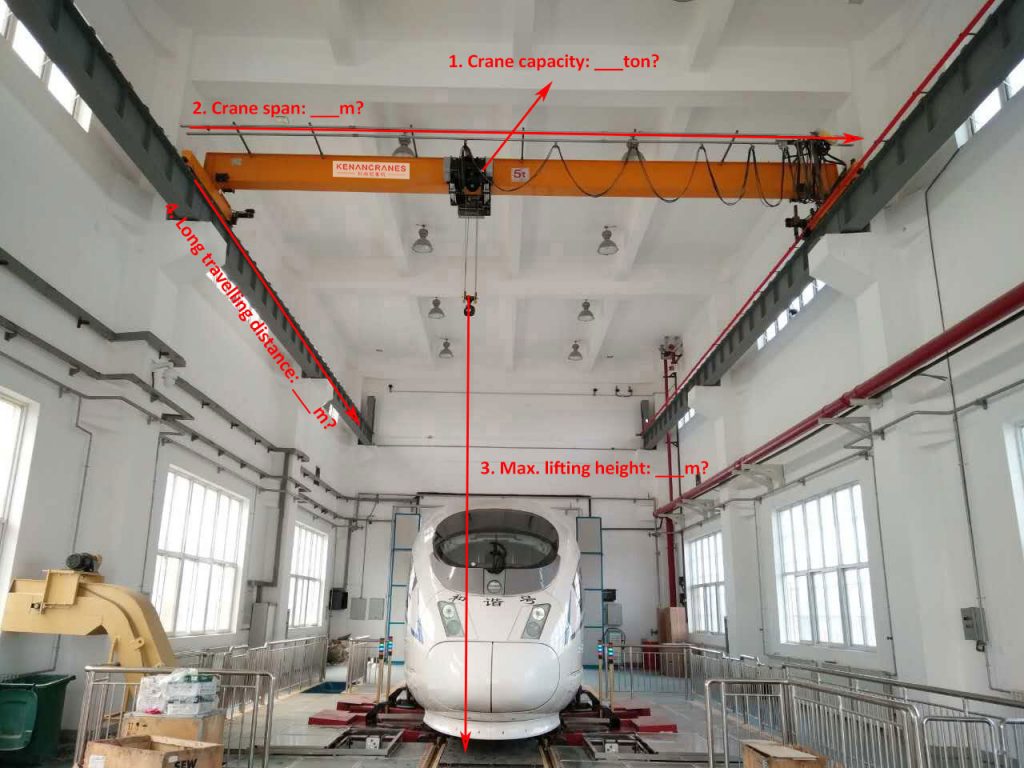
Capacity — the heaviest regular load, plus any below-the-hook device. Don't size the whole crane for a once-a-year lift.
Span — the building width the crane must cover, rail to rail.
Lifting height — floor to hook at the top, checked against your racking and roof steel.
Duty — how many lifts per hour and hours per day; this sets the working class, and it's set by real usage, not capacity.
Headroom & layout — low-headroom hoists and the single-vs-double choice both affect how much of your building height stays usable.
When you can answer those, the overhead crane inquiry guide turns them into the specs that get an accurate quote back within 24 hours.
Talk to an engineer
Tell us the load, the span and the building, and our engineers return a configuration and budget price within 24 hours — send a photo of the bay and it goes faster. WhatsApp +86 190 3730 3917 or email [email protected]. Browse the overhead crane range to see configurations and indicative pricing.
Thank you for your interests in Kinocranes. Please feel free to submit your inquiry information to us. Our sales manager will contact with you as soon as possible.

 Customized Crane