Plain-language articles from our engineers — crane types, components, safety and maintenance. All published on this site; organized and searchable so you can actually find them.
A gantry crane is a lifting machine that carries its own support. Instead of running on elevated runway beams fixed to a building, the bridge girder sits on legs that travel along rails at ground level — or on rubber tyres with no rails at all. The lifting principle is the same as an overhead (bridge) crane; what changes completely is the crane's relationship with the building, because there doesn't need to be one.
How a gantry crane works — the main parts
Every gantry crane is built from the same core assemblies. Understanding them makes the type names below obvious:
Bridge girder — the horizontal beam the load travels along. A single box or I-beam on light cranes; two parallel girders on heavy or wide-span cranes.
Legs (uprights) — carry the girder down to ground level. On a full gantry both sides have legs; on a semi-gantry one side has a leg and the other rides a building runway.
End carriages & travel wheels — sit under the legs and move the whole crane along the rails (long travel).
Hoist & trolley — the trolley crosses the girder (cross travel) while the hoist raises and lowers the load. Wire-rope hoists for heavier duty, electric chain hoists for lighter.
Controls & power — pendant or radio control; power fed by cable reel, festoon or conductor bar (rail types), or an onboard diesel-generator / battery on rubber-tyred machines.
The gantry crane family
Gantry cranes are grouped three ways — by structure, by how they move, and by the specialised jobs they are built for.
By structure
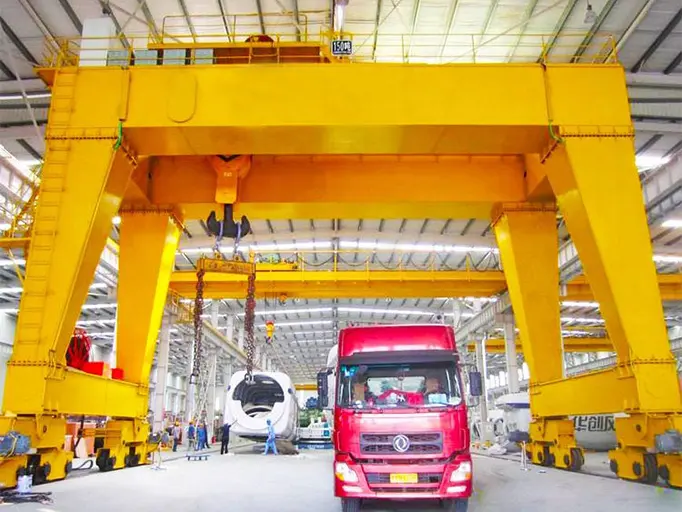
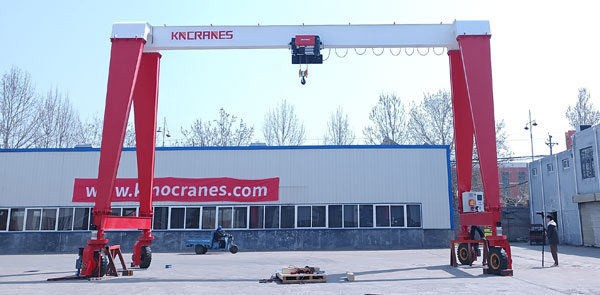
Single girder — one girder, most economical, ideal for light-to-medium loads and moderate spans (typically up to ~20 t).
Double girder — two girders for heavy loads, wide spans and greater hook height; the trolley runs on top, so lifting height is maximised. See the full single vs double girder comparison.
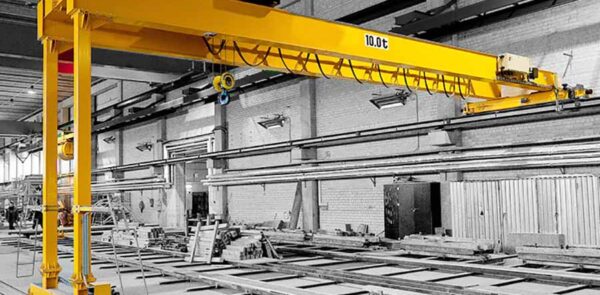
Semi-gantry — one leg on a ground rail, the other end running on an existing building runway. A money-saver when one side of the bay already has structure.
By mobility
Rail-mounted gantry (RMG) — travels on fixed ground rails; the standard yard and workshop configuration.
Rubber-tyred gantry (RTG) — travels on tyres, no rails needed, free to move and steer between rows — the container-yard workhorse. More in what is an RTG crane.
Portable / adjustable gantry — small, often aluminium or light steel, moved by hand and sometimes adjustable in span and height. See the portable gantry buying guide.
Specialised gantries
Container gantry — RMG/RTG fitted with a spreader for 20'/40' containers in ports and depots.
Shipyard (Goliath) gantry — very high capacity and span for assembling hull blocks.
Construction / precast gantry — for bridge segments, precast concrete and structural yards.
Cantilever gantry — the girder extends past the legs so the hook can serve trucks or storage outside the rail track.
Not sure which family fits? Start broad with types of gantry crane, or tell us the job and we'll point you to the right one.
Typical capacities and spans
Gantry cranes cover an enormous range. Kino Cranes builds the full family from 1 to 500 tonnes, with spans commonly up to 35 m and beyond on custom shipyard and precast machines. As a rough guide: portable and light-duty units run 0.5–5 t; general workshop and yard gantries 5–50 t; heavy industrial, port and shipyard machines from 50 t upward. The right capacity is set by your heaviest regular load plus any below-the-hook device (spreader, magnet, grab), never by a once-a-year lift.
Gantry crane vs overhead crane
Gantry crane
Overhead (bridge) crane
Support
Own legs on ground rails, or tyres
Runway beams on building columns
Building required
No
Yes — with adequate structure
Best environment
Outdoor yards; also indoor when structure is off-limits
Indoor production bays
Floor impact
Legs and rails occupy floor space
Floor stays completely clear
Installation
Mostly civil work — rails and foundations
Structural — runway on the building frame
Relocation
Relatively feasible
Tied to the building
Working indoors with a solid building frame? An overhead crane keeps the floor clear and is usually the better fit.
When a gantry crane is the right choice
Choose a gantry when the runway can't — or shouldn't — hang from structure:
No building at all — open yards, stockpiles, laydown areas.
Structure can't take crane loads — columns or roof not rated for a runway.
Rented or temporary premises — where you can't modify the building.
Operations that may relocate — a gantry brings its own supports and moves with you.
Because the crane carries its own legs, installation is mostly civil work (rails and foundations) rather than structural modification — which can reduce changes to the building's main structure. It does not mean "no civil work", though: rails, foundations, power supply, drainage and site levelling still have to be assessed.
Where gantry cranes work
Shipyards assembling hull blocks, container terminals and inland depots, railway and precast concrete plants, steel stockyards, mine and mineral-processing yards, power plants, and bridge construction sites — anywhere heavy loads move through open air or a building can't carry a crane.
Advantages and limitations at a glance
Advantages: no building structure needed; works outdoors; lower-cost installation (civil, not structural); relocatable; huge capacity range. Limitations: legs and ground rails occupy floor space and can obstruct traffic; long-travel path must be kept clear; foundations and rails are a civil cost overhead cranes avoid when a building already exists.
How to choose a gantry crane
Rated capacity is not the only thing that decides a gantry crane — and the fastest route to a wrong quote is to start by naming a single girder, an A5 duty class or a particular brand of component. Our engineers scope every gantry in the same order, confirming five things before any structure or duty class is fixed.
1. Confirm the load and the lifting device
The heaviest load, its shape and dimensions, its centre of gravity, and how it is lifted — hook, spreader, grab, magnet or other attachment. The weight and working requirement of the attachment itself must be built into the plan, not added afterwards.
2. Confirm the space
Span, lifting height, travel distance, rail layout, clearances, leg positions, loading boundaries and vehicle access. These become the General Arrangement (GA) drawing — the document that fixes the main dimensions, structure, interfaces and supply boundary, and that both sides sign off before anything is built.
3. Confirm usage intensity and environment
How often it works (lifts per hour, hours per day, shift pattern), the working cycle, and the environment — indoor or outdoor, dust, rain, corrosion, high temperature, wind load. The duty class, structure and configuration are set from this by engineering, never from capacity alone; under-stating the duty wears the crane out years early.
4. Confirm the site interfaces
Rails and foundations, building interfaces, power supply and control method, earthing, drainage, maintenance access, and transport and installation conditions — plus local regulations, acceptance requirements and documentation.
5. Confirm the solution and acceptance scope
Engineering turns the requirements into drawings and a technical specification. Once you confirm the final GA drawing, manufacture and testing proceed to the contract, technical agreement and inspection plan. Typical tests — hoisting, long and cross travel, interlocks and limit functions — are run and recorded before shipment.
Two things worth saying plainly: a gantry crane is not "a crane with no foundation" — rails, foundations, power, drainage and site levelling still have to be engineered. And the final GA drawing is where structure, dimensions, interfaces and supply boundary are agreed, so no one discovers a mismatch after production has started.
Thank you for your interests in Kinocranes. Please feel free to submit your inquiry information to us. Our sales manager will contact with you as soon as possible.

 Customized Crane