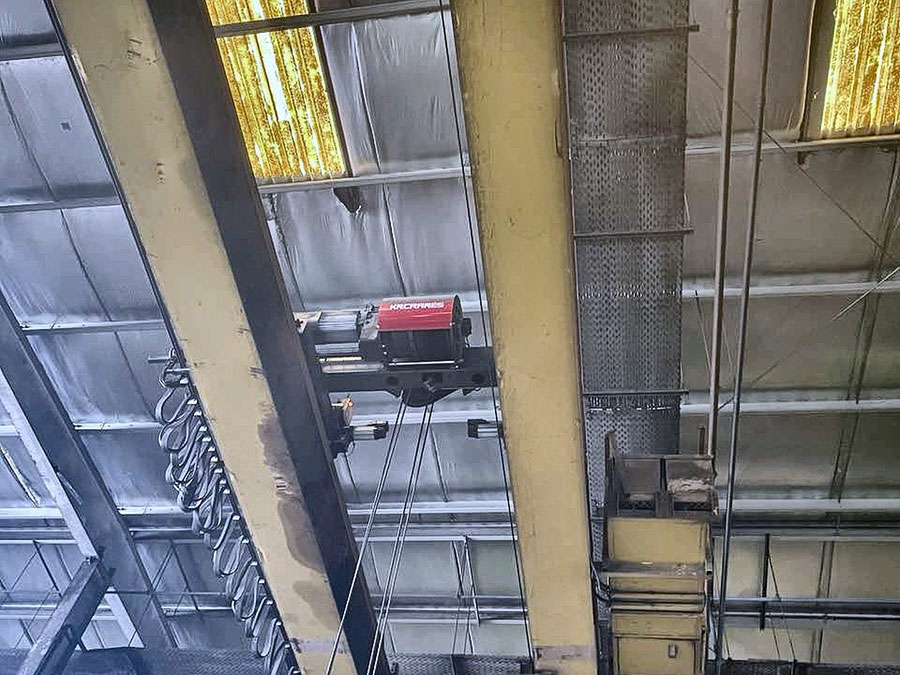
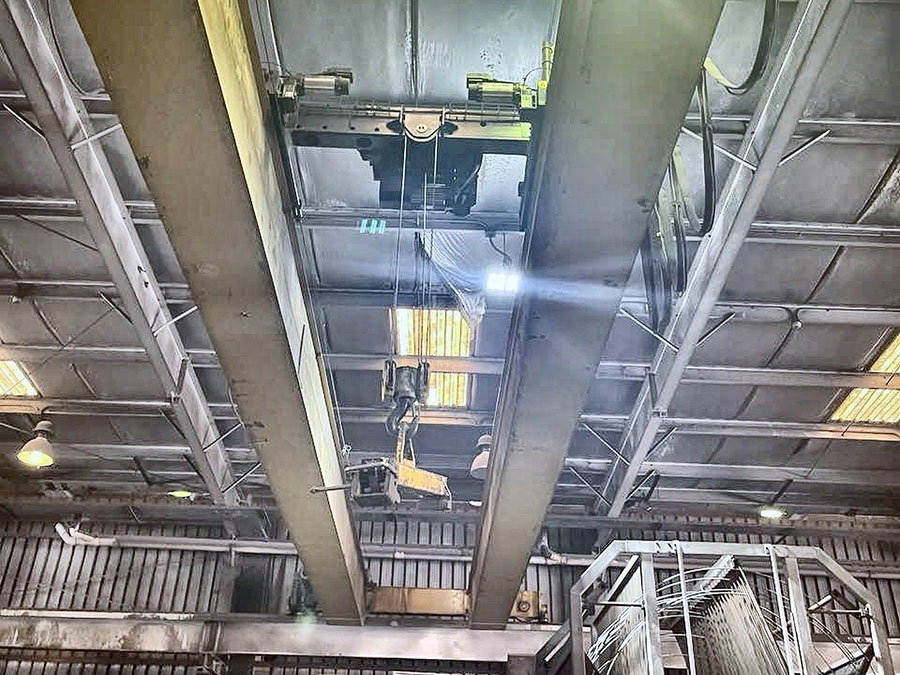
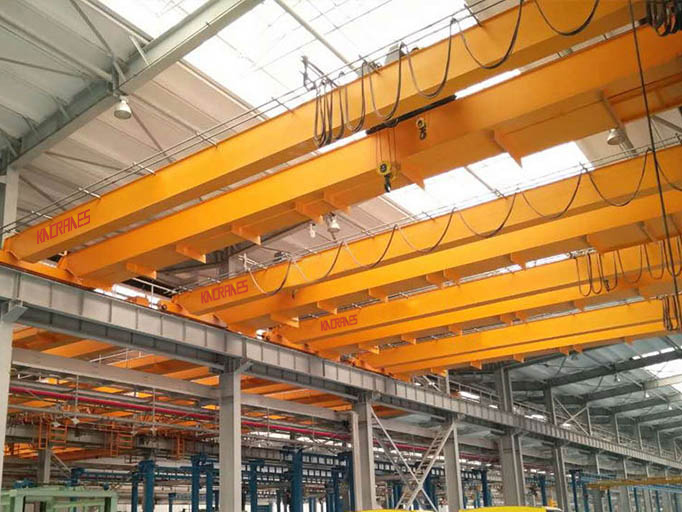
A steel wire plant in the Eastern Province of Saudi Arabia runs a workshop full of European-built overhead cranes. The girders are sound. The runways are sound. The hoists are not — and neither are the geared motors, the current collectors or the festoon gear.
Since 2021 we have supplied that plant with replacement hoists and travel components built to the interfaces of the cranes it already owns. Twenty-four deliveries over six years, every year from 2021 to 2026, every one installed by the plant’s own maintenance team. We have never sent an engineer to site.
24Deliveries since 2021
6 yearsContinuous supply
1605 mmAs-measured rail gauge
60 HzSupply frequency
FEM 2mDuty classification
0Engineers sent to site
Project Background and Requirements
The plant manufactures steel wire and wire products — drawn wire and bar, welded mesh, galvanised and PVC-coated wire, prestressing strand. Production runs from coil to finished reel, and the overhead cranes carry material at every stage of it. Cranes in that kind of plant work constantly.
The consequence is predictable and it is the reason this account exists: the running gear wears out long before the structure does. A girder is designed for decades. A hoist is designed for a duty cycle, and when it reaches the end of that cycle the building around it is still perfectly good.
For a Gulf plant running European equipment, that creates a specific problem. OEM replacement parts carry OEM prices and OEM lead times, and neither scales well when components reach end of life one at a time across a fleet of cranes. Replacing whole cranes to solve it makes no economic sense at all — the structural steel has years left in it.
So the requirement was never “supply a 5 tonne hoist”. It was: supply a hoist that will bolt onto a crane that is already hanging in this building, at a price and lead time that make replacement worth doing, and make it something our own fitters can install.
The constraint that set the design
A replacement component that does not fit is not a cheaper option — it is scrap plus a shutdown. Everything in this account has been built around getting the interface right the first time, because there is no engineer on a plane to fix it if it is wrong.
Technical Specifications
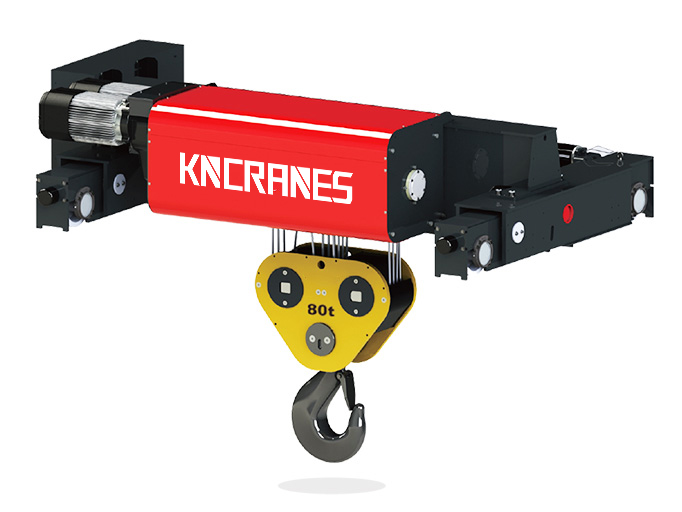
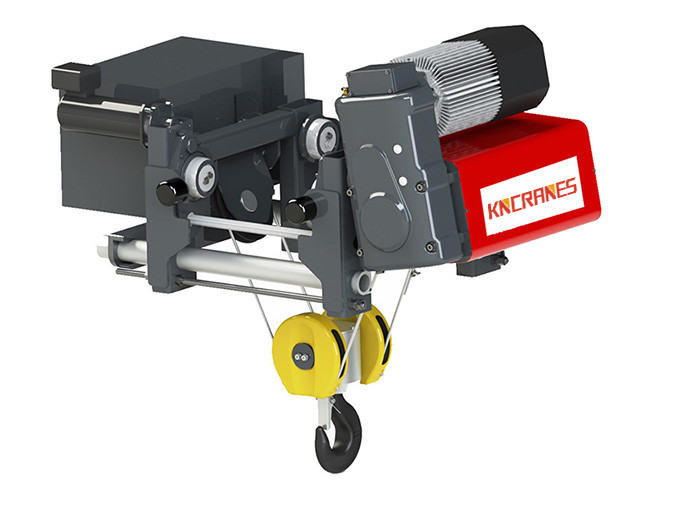
One of the 5 tonne double girder wire rope hoists supplied to this plant, as an illustration of what “built to the existing crane” means in practice:
Rated Capacity
5 t
Lifting Height
4.5 m
Cross Travel Rail Gauge
1605 mm — measured from the crane in service
Rope Reeving
4/1 — four rope falls
Hoisting Speed
5 / 0.8 m/min, two speed
Cross Travel Speed
0–25 m/min, variable frequency
Hoisting Motor
5 / 0.7 kW
Cross Travel Motor
2 × 0.3 kW
Hook
Grade T
Duty Classification
FEM 2m
Protection / Insulation
IP54 / Class H
Control
Radio remote control
Power Supply
380 V / 60 Hz / 3 phase
Installation
Carried out by the plant’s own maintenance team
Three of those lines decide whether the hoist can be installed at all.
The 1605 mm rail gauge is not a catalogue size. It is the gauge of the cross travel rails on one specific crane in that building. A hoist built to the nearest standard frame width does not sit down on those rails, and a few millimetres is the whole difference between a working crane and a crated machine in a yard.
Reeving and lifting height together set the drum size and the overall height of the unit, which has to clear inside the headroom the original girder leaves. Get this wrong and the hoist fits the rails but not the building.
Saudi Arabia runs at 60 Hz. Motors and drives have to be specified for it. A default 50 Hz configuration will run, and it will run at the wrong speed with the wrong torque characteristic, which is a problem discovered at commissioning rather than at quotation.
Key Engineering Points
01The work is in the checking, not the building
Manufacturing a 5 tonne hoist is routine. Establishing that this particular 5 tonne hoist will fit that particular crane is not. Rail gauge and rail profile, reeving and drum capacity against available headroom, duty class translated properly between FEM and ISO, supply voltage and frequency, and the control interface to the existing panel — every one of them is confirmed before anything is cut.
02Duty class is translated, not assumed
European cranes are classified under FEM and ISO. Substituting a component rated under a different national standard without doing the translation properly produces a unit that looks equivalent on paper and has a different service life in the building. Each replacement here is specified against the FEM/ISO class of the crane it goes onto.
03Built for the Gulf and for the process
Wire production involves pickling and other corrosive stages, and the ambient conditions add heat and humidity on top. The very first order on this account, back in 2021, was an acid-protected cable trolley. Current collector brushes, C-rail and festoon components have been supplied repeatedly since. Power collection wears out far faster here than the same equipment would in a temperate workshop, and it is worth specifying for that.
04Designed so the plant fits it without us
Twenty-four deliveries, no engineers deployed. That is only possible because the interface is right on arrival. When a component reaches end of life, the plant does not open a service ticket and wait for a visa and a schedule — it takes delivery and its own fitters change the part over.
05One supplier across component types
Wire rope hoists, chain hoists from 250 kg to 5 t, long travel geared motors, collector brushes, C-rail and cable trolleys, radio remotes, hoist rope, cable. Sourcing all of it through one channel that already holds the interface data for the plant’s cranes removes most of the work from the plant’s side of each transaction.
How the Relationship Was Built
There was no tender and no framework agreement. The first order in May 2021 was a single acid-protected cable trolley — a few hundred dollars of hardware. It was not a purchase, it was a test: could this supplier understand a European interface specification well enough to send something that fits?
It fitted. What followed was a hoist, then a brake set, then a long travel geared motor, then collector brushes. By late 2022 the plant had ordered a complete new single girder crane from us — 5 t, 27.5 m span, FEM A5. From replacement components to a whole machine, on the strength of parts that arrived and went on.
Year
Deliveries
What was supplied
2021
1
Acid-protected cable trolley — first order
2022
7
Wire rope and chain hoists, brake sets, long travel geared motors, collector brushes, radio remote — and a complete 5 t / 27.5 m single girder crane
2023
3
Double girder wire rope hoists, chain hoists, European hoist spares
2024
5
Wire rope and chain hoists, geared motors, C-rail and cable trolleys
2025
4
Wire rope and chain hoists with trolleys, geared motors, radio remotes
2026
4
Cable, hoist rope and running spares
The list is the result. A plant does not keep buying for six years from a supplier whose parts do not fit. Each repeat order is evidence that the previous interface check was right — and this account has never had one that was not.
Quality Assurance
Every replacement unit specified against the as-measured interface data of the crane it is going onto — rail gauge, rail profile, headroom, control interface
Duty class translated between FEM / ISO systems rather than substituted from a national standard
Supply voltage and frequency confirmed per unit before manufacture; 60 Hz is not assumed to be 50 Hz
Components for corrosive and high-humidity service specified for that environment, not supplied as standard build
Interface data retained between orders, so a repeat enquiry for the same crane does not start from scratch
What This Approach Does Not Cover
Replacing a hoist does not extend the life of a girder. If the structure shows fatigue cracking, section loss or permanent deflection, a new hoist puts a fresh mechanism on a crane that is closer to retirement than the mechanism was, and the money would be better spent on the crane.
Nor does it work if the required capacity has risen since the crane was installed. The girder was designed for its original rating, and a bigger hoist does not change what the structure can carry. That is a new crane, and we would tell you so.
And a replacement unit is only worth having if the interface data is real. Dimensions copied from an original data sheet are not the same as dimensions measured on the crane — cranes get modified, rails get replaced, and the drawing in the file may be describing a machine that no longer exists in that form.
Customer Value
Structure retained — girders, runways and building untouched; only end-of-life mechanism replaced
Maintenance cost controlled — purpose-built replacement units in place of OEM channel pricing, at the same duty class
Downtime shortened — parts available when a component reaches end of life, fitted by the plant’s own team, no waiting on a service visit
One channel across component types — hoists, geared motors, collectors, festoon gear and rope from a single supplier that holds the interface data
Specified for the environment — acid-protected and Gulf-climate components where the process demands it
Why Choose Kinocranes for Replacement Hoists
Hoists and travel components built to the as-measured interfaces of European-built cranes already in service
Duty class specified under FEM / ISO, matched to the crane rather than converted after the fact
50 Hz and 60 Hz supply handled as a specification item, not an afterthought
Components for corrosive process environments and Gulf climate
A compatibility answer before a quotation — we will tell you if it will not fit
Will a replacement hoist fit your existing crane?
If your girders and runways are sound but the hoist, geared motor or current collector has reached end of life — and OEM pricing and lead times are getting difficult — replacing the mechanism and keeping the structure is usually the better option. Send us these and we will confirm compatibility before we quote:
Make and model of the existing hoist — a nameplate photo is ideal