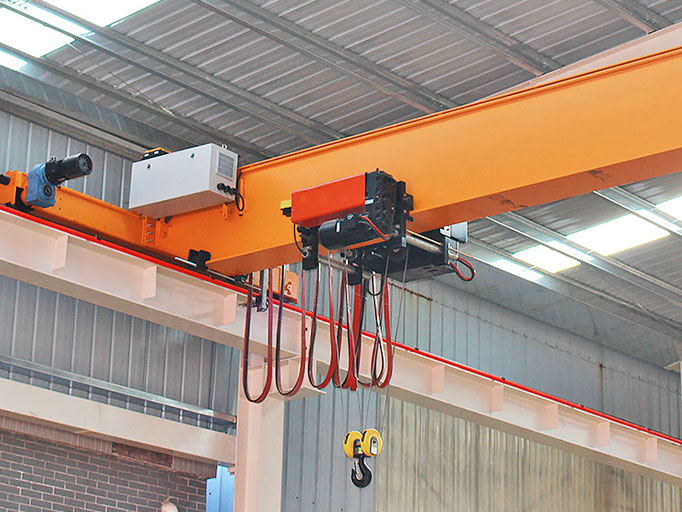
The customer already had the hoist. What they did not have was a crane.
A North American equipment distributor and integrator, working across the United States and Mexico, had bought an electric wire rope hoist for a project in El Paso, Texas. A hoist on its own lifts nothing. It needs a girder to run along, end carriages to carry that girder, a runway for the end carriages to travel on, columns to hold the runway up, electrification to feed the whole thing, and a control system to drive it. Buying a complete crane would have meant paying for a second hoist and throwing the first one away.
So we supplied everything except the hoist, and designed all of it around the one they already owned.
10 tRated capacity
31 ftSpan (9.4488 m)
10 ftLifting height (3.048 m)
45 ftRunway length (13.716 m)
220 V / 60 HzPower supply
FEM A5Crane classification
Project Background and Requirements
The customer is a distributor and integrator rather than an end user, supplying machinery into projects on both sides of the US–Mexico border. For this job in El Paso, Texas, the hoist had already been procured. The rest of the crane had not.
That is a more common situation than it sounds, and it is usually handled badly. The two normal outcomes are that the customer buys a complete crane and writes off the hoist they already own, or they buy structure from one supplier and spend the commissioning period watching two vendors argue about whose interface is wrong.
Three things had to be true for the third option to work.
The mechanical interface had to be right the first time. The hoist runs on the bottom flange of the main girder. Its wheel gauge, wheel profile, headroom and hook approach are fixed facts about a machine that was already sitting in a crate. The girder had to be designed to them, not the other way round.
The electrical interface had to be right the first time. The hoist has its own motors, brake, limit switches and control wiring. Our control panel, radio remote and travel drives had to work with them as one system, at 220 V / 60 Hz with 48 V controls.
Responsibility had to be unambiguous. If the boundary is vague, every fault on site becomes a negotiation. The quotation and the proforma invoice both stated plainly that the hoist was buyer-supplied and that everything else was ours, designed against the hoist drawings the customer provided.
The constraint that set the design
The hoist was a fixed input, not a variable. Every dimension and every electrical decision in this project was derived from a machine that had already been bought — which is the opposite of how a crane is normally engineered.
Scope of Supply
The clearest way to describe this project is to state who supplied what.
Supplied by the customer
Supplied by Kinocranes
Electric wire rope hoist
Main girder, 9.4488 m span, Q235B box section
Hoist electrical drawings, as design input
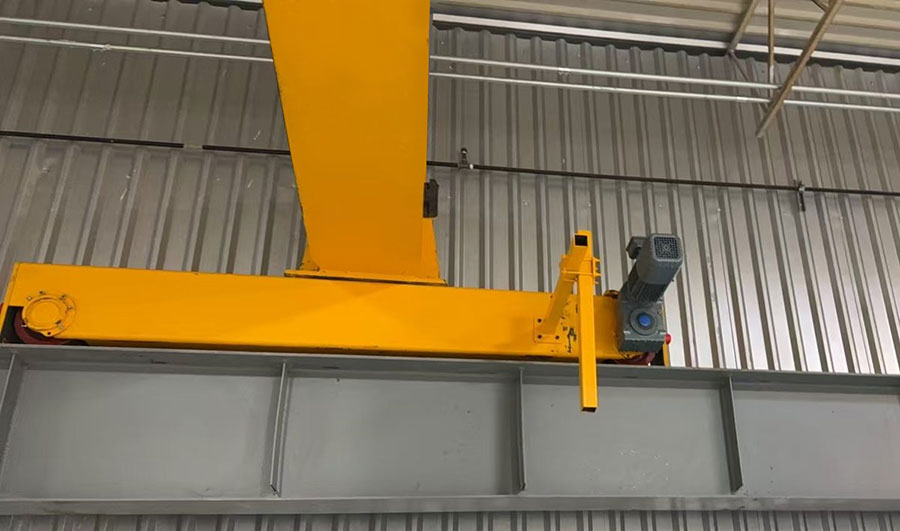
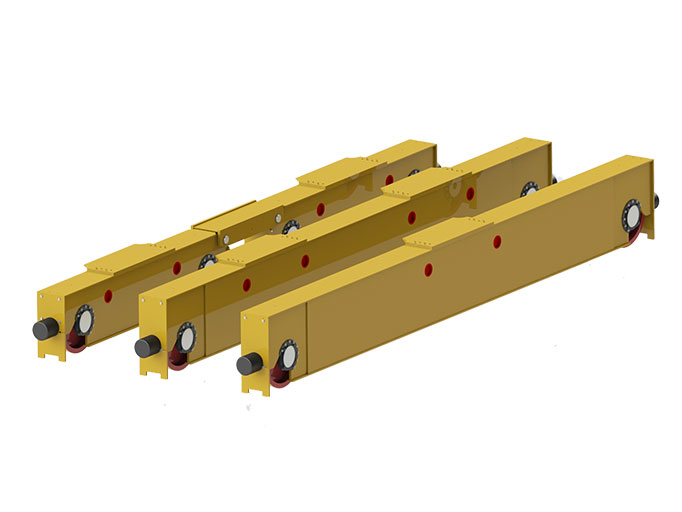
End carriages, 2 sets, with travel geared motors and wheels
Site installation labour
Control panel with variable frequency drives
Radio remote control system
Festoon power supply system across the full 9.4488 m
Conductor bar, 4 × 10 mm², 13.716 m, with fixings
Square bar crane rail, 50 × 30 mm, 2 × 13.716 m
Columns, H350 × 200 × 6 × 10 × 4419 mm, 6 off
Runway beams, H550 × 280 × 200 × 6 × 12 × 10 × 6858 mm, 4 off
End stops, 4 off; English installation and maintenance manuals
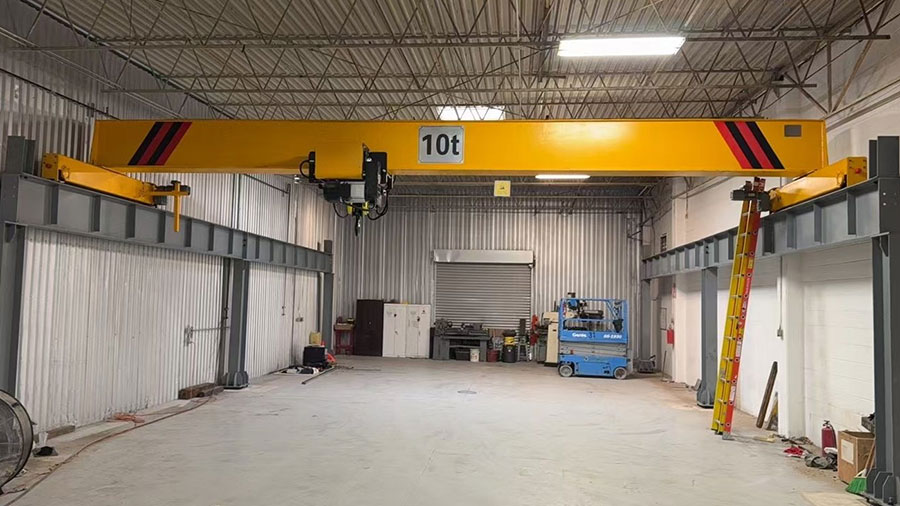
The building had no crane runway and no columns capable of carrying one, so the runway system came with the crane. That matters for the same reason the hoist interface matters: hook to foundation was designed as one load path, by one party.
Technical Specifications
Crane Type
European style single girder overhead crane, customer-supplied hoist
Quantity
1 set
Rated Capacity
10 000 kg (10 t)
Span
9.4488 m (31 ft)
Lifting Height
3.048 m (10 ft)
Runway Length
13.716 m (45 ft)
Crane Classification
FEM A5
Mechanism Group
FEM 2m (ISO M5)
Hoisting Speed
6 / 0.96 m/min, two speed
Long Travel Speed
0–32 m/min, variable frequency
Power Supply
220 V / 60 Hz / 3 phase
Control Voltage
48 V
Control
Radio remote control, 48 V, IP55
Control Panel
IP55 enclosure, Schneider components, variable frequency drives
Main Girder
Q235B box girder
Wheels
Ø200 mm, 4 off
Total Installed Power
11.6 kW, complete system including the customer’s hoist
Total Weight
3 300 kg, including the customer’s hoist
Surface Preparation
Sa 2.5 blast cleaning, 120 µm dry film thickness
Protection
Hoisting and cross travel limits, emergency stop, overload, short circuit, overheat, overspeed, overcurrent, phase failure and earth fault protection; anti-collision, warning light, trolley end stops and buffers
Delivery
40 days from receipt of deposit, DDU El Paso, Texas
Key Engineering Points
01Every dimension is a whole number of feet
Span 9.4488 m is 31 ft. Lifting height 3.048 m is 10 ft. Runway 13.716 m is 45 ft. Columns 4419 mm are 14 ft 6 in; runway beams 6858 mm are 22 ft 6 in. Nothing here was designed in metric and converted afterwards — the geometry was set in the units the building was built in, and the metric figures are what came out. On a US project that is not cosmetic: it is what lets the crane land on foundations and steelwork that were laid out in feet and inches.
02The girder was designed to the hoist, not to a catalogue
On a normal crane the hoist and the girder come from the same drawing set. Here the hoist was a fixed object with a fixed wheel gauge, fixed headroom and a fixed hook approach. The bottom flange width, the flange thickness and the girder depth all follow from it. Get the flange wrong and the hoist does not sit on the beam; get the depth wrong and 10 ft of hook travel is no longer 10 ft.
03One control system, two suppliers’ machinery
We asked for the hoist electrical drawings twice before the panel was built, and we did not start the control design until we had them. The result is a single system: one radio remote drives the customer’s hoisting motions and our long travel drives, with limits, interlocks and emergency stop working across both. The alternative — two independent control systems on one crane — is a maintenance liability for as long as the crane exists.
04Specified for a 220 V / 60 Hz site
US supply is 60 Hz, and this site runs at 220 V. Motors, drives and the control transformer were specified for it rather than adapted from a 50 Hz standard build. Control voltage is 48 V, which keeps the pendant and remote circuits at a level the customer’s own electricians can work on safely.
05Delivered to the point of use, not the port
The original quotation was CIF Dallas. The customer moved the delivery point to El Paso, and the final proforma invoice was reissued DDU El Paso, shipped by sea and rail. On a project where the buyer is doing their own installation, landing the equipment at the site rather than at a port removes the part of the logistics chain they are least equipped to manage.
06A stated boundary, in writing
The quotation and the proforma invoice both record that the electric hoist is buyer-supplied and that the remainder of the crane and runway system is ours. That sentence is worth more than it looks. It is the reason nobody had to argue about scope when the equipment arrived.
What We Needed to Know Before Quoting
For a project built around equipment somebody else supplied, the enquiry stage is the engineering. These are the items that had to be settled before a price meant anything:
What we needed
What it determined
Hoist wheel gauge and rail profile
Bottom flange width and thickness of the main girder
Hoist headroom and hook approach
Girder depth, and whether the required lifting height was achievable
Hoist electrical drawings
Control panel design, interlocks, limit circuits, remote channel allocation
Supply voltage and frequency at site
Motor, drive and transformer selection — 220 V / 60 Hz, not a 50 Hz build
Building span and available runway length
Girder length, runway beam and column layout, conductor bar length
Who installs it
Level of detail in the drawings and manuals, and what support had to be available remotely
Everything on that list is information the customer had. None of it is information a supplier can assume.
Delivery and Installation
Enquiry received January 2024, scoped from the outset as structure and electrics rather than a complete crane
Order placed and proforma invoice issued within a week of the quotation
Delivery point changed from Dallas to El Paso before shipment; final terms DDU El Paso, by sea and rail
Manufacturing lead time 40 days from receipt of deposit
Installation carried out by the buyer, with free online video guidance from our engineers; on-site supervision available separately
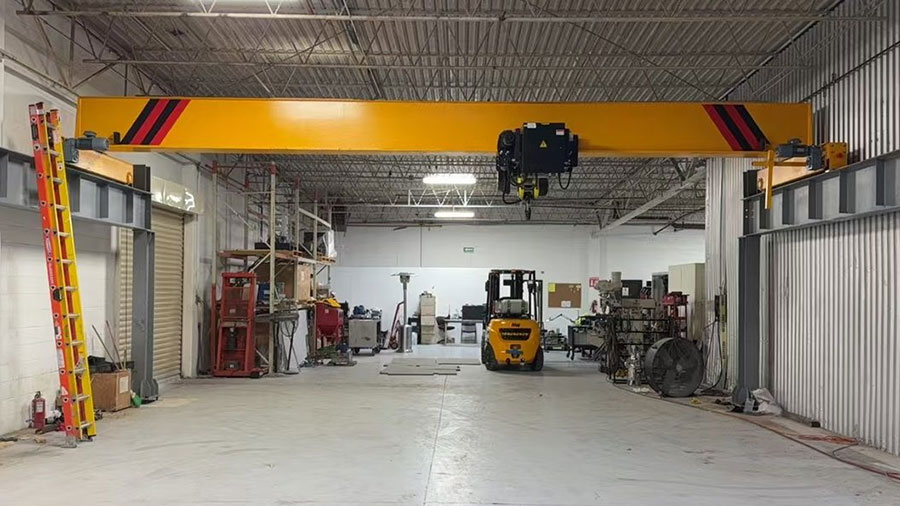
Site photographs confirm the main girder, end carriages, columns, runway system and the customer’s hoist all installed and in position
The customer returned in 2025 for control pendant components
We are describing what the photographs and records show, which is a completed mechanical installation. Commissioning, load testing and formal handover are the customer’s own steps and we make no claim about them here.
When Building Around an Existing Hoist Is the Wrong Choice
This approach saves the cost of a hoist. It does not save the cost of getting it wrong, and there are cases where buying a complete crane is simply the better decision.
If the hoist has no documentation — no drawings, no nameplate, no wheel gauge you can measure — then the interface is a guess, and a guess that arrives as a 9 metre girder is an expensive one. If the hoist is near the end of its own service life, matching a new structure to a worn mechanism buys a crane that will need opening up again shortly. And if the hoist duty class does not match the work the crane will actually do, the hoist becomes the limiting component of a machine built around it.
The test is whether the hoist is a known quantity. Where it is, integrating around it is straightforward engineering and it saves real money. Where it is not, the honest answer is that the saving is not worth the risk.
Customer Value
No duplicate purchase — the hoist already owned stayed in the project instead of being written off
A single responsible party for everything else — girder, end carriages, controls, electrification, columns and runway from one supplier, designed as one system
A stated scope boundary — recorded in the quotation and proforma invoice, so nothing was ambiguous when the equipment arrived
Specified for the site, not adapted to it — 220 V / 60 Hz, and principal dimensions set in feet
Delivered to the point of use — DDU El Paso rather than a port, on a project the buyer installed themselves
Why Choose Kinocranes to Complete an Existing Hoist
Girders and end carriages designed to the hoist you already have, from its drawings and measured dimensions
One control system across both suppliers’ machinery, not two systems sharing a crane
50 Hz and 60 Hz, and imperial site geometry, handled as specification items rather than conversions
Runway beams, columns, conductor bar and rail supplied with the crane where the building has none
A compatibility answer before a quotation — including when the answer is that it will not work
Already own the hoist and need the rest of the crane?
If you have a hoist and need the girder, end carriages, controls, electrification or a complete runway system to go with it, send us the following and our engineering team will confirm what will fit before quoting anything:
Hoist nameplate photograph and general arrangement
Hoist electrical drawing
Wheel gauge, rail profile and headroom of the hoist
Required capacity, span and lifting height
Building span, available runway length and whether a runway already exists