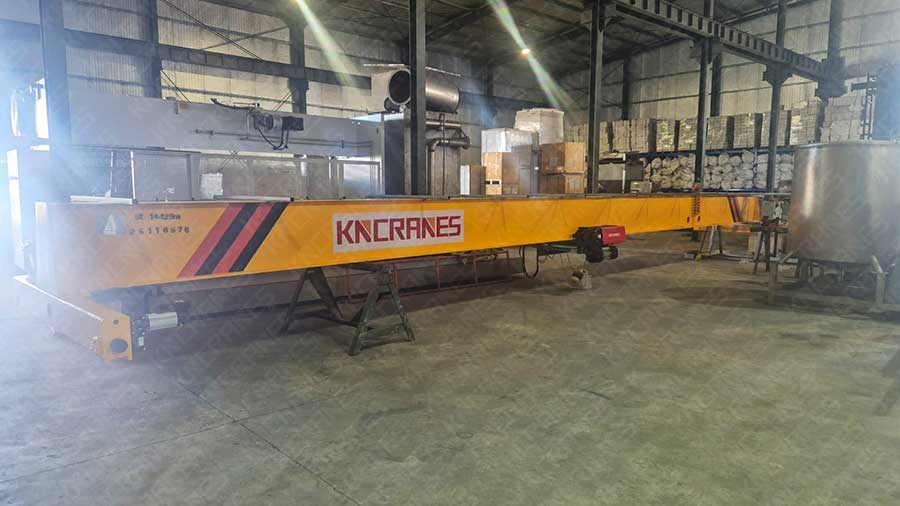
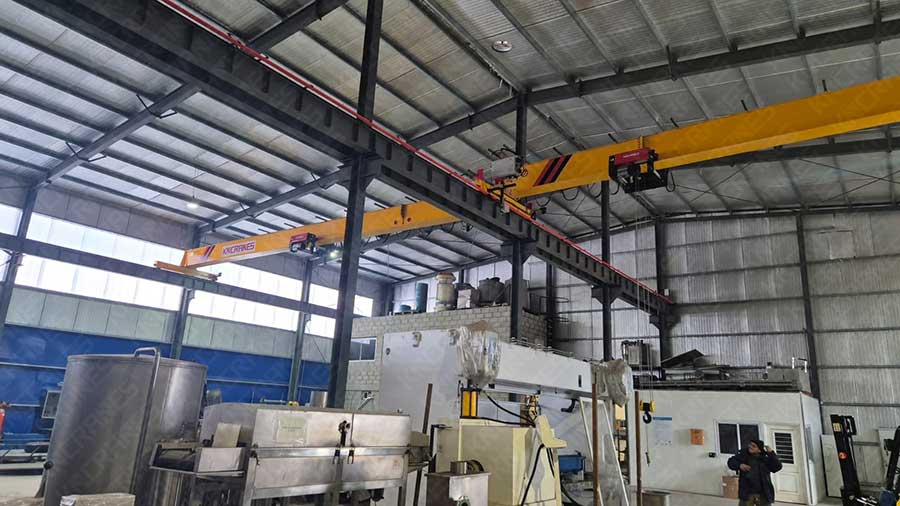
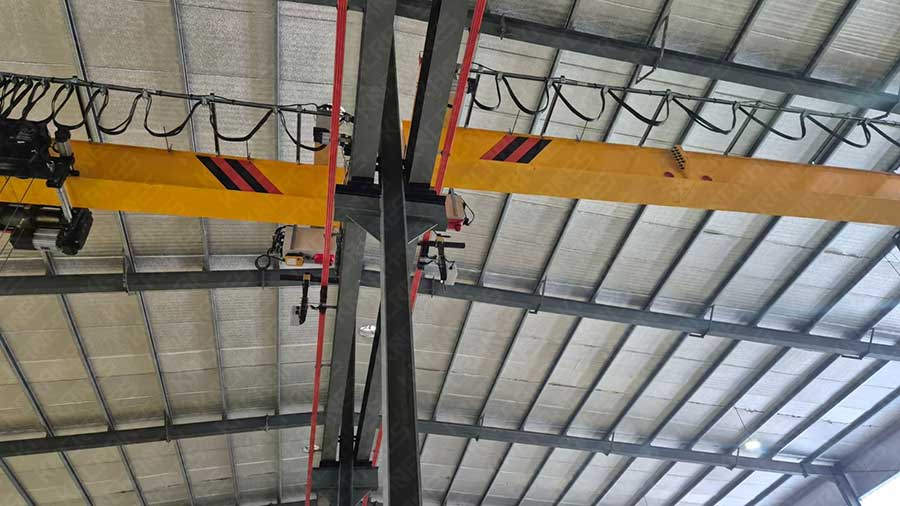
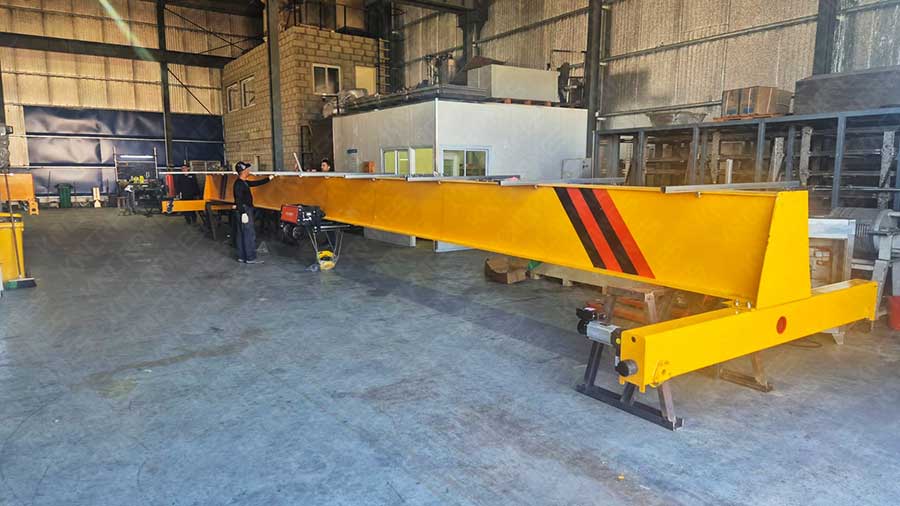
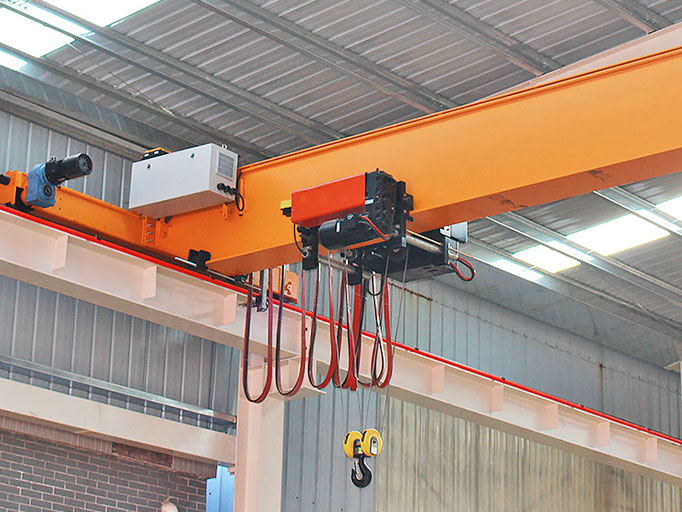
In October 2025, Kinocranes supplied a 5 Ton European Single Girder Overhead Crane together with its supporting traveling beam system to a food and beverage manufacturer in Argentina. The customer came to us on the recommendation of an existing client. The crane spans 14.129 m at 6.2 m lifting height and works above the production floor, handling process equipment and materials in a hall that was never built with an overhead crane in mind.
5 tRated capacity
14.129 mSpan
6.2 mLifting height
M5Duty group
0.3 kW × 2Bridge drive
48 VControl voltage
Project Background and Requirements
The plant produces food and beverage products. Lifting here is not the main activity — it supports it: moving process equipment for cleaning and maintenance, positioning vessels and machine parts, and handling incoming materials without tying up a forklift in a hall full of stainless steel and hygiene boundaries. What the customer needed was reliable, controllable lifting across the full width of the production floor.
The crane was the easy half
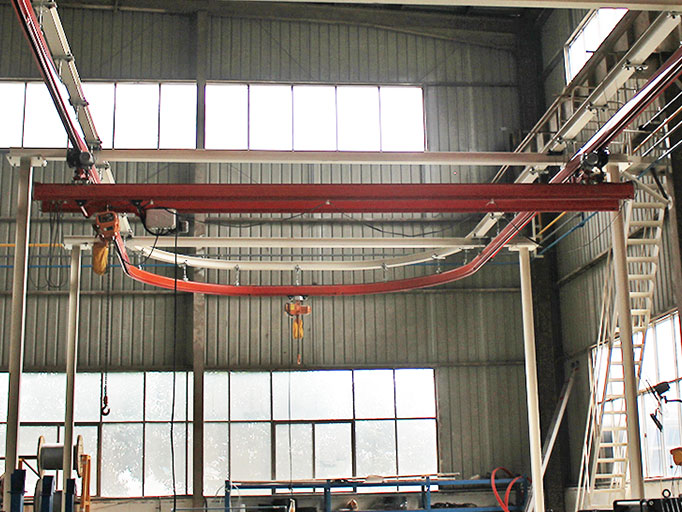
This plant had no crane runway. The scope was not just a 5 t crane — it was the crane plus the supporting traveling beam system it runs on. Where a building was never designed to carry an overhead crane, the runway and its support steel are the part that decides whether the project is possible at all.
The enquiry arrived as a referral from an existing Kinocranes customer, which shortened the trust-building part of the process considerably but raised the bar on response. We produced a customized European standard configuration, technical scheme and quotation quickly, and the order was placed on 14 October 2025.
Technical Specifications
The delivered 5 Ton European Single Girder Overhead Crane features the following key specifications. These parameters define the working envelope for production support in a food and beverage plant and provide a clear basis for equipment inspection and operation:
Model
KS 5t-14.129m-H6.2m
Crane Type
European Single Girder Overhead Crane + supporting traveling beam system
Rated Capacity
5 T
Span
14.129 m
Lifting Height
6.2 m
Working Class
M5
Quantity
1 set
Hoisting Speed
5 / 0.8 m/min (dual speed)
Trolley Travelling Speed
0–20 m/min (variable frequency)
Bridge Travelling Speed
0–32 m/min (variable frequency)
Bridge Drive Motor
T3 series, 0.3 kW × 2
Trolley Gauge
410 mm
Main Beam Height
610 mm
Bridge Rail Model
P22
End Carriage Model
DN14-22
Power Supply
380V / 50Hz / 3 Phase
Control Voltage
48 V
Working Environment
Indoor, food and beverage production hall
Key Engineering Features
01Supplied with its supporting traveling beam system
A food plant built as a clear-span shed usually has no crane runway and no columns designed to carry one. Kinocranes supplied the traveling beam system together with the crane so that the load path from hook to foundation was designed as one thing, rather than leaving the customer to source runway steel separately and hope the two match.
02European single girder, 610 mm beam depth
The main beam is 610 mm deep across a 14.129 m span. Keeping the girder shallow preserves hook height under a low roof, which is the constraint that usually bites in a food or beverage building where the eaves were set by process equipment, not by lifting.
03Dual-speed hoisting, 5 and 0.8 m/min
The creep speed is the one that matters. Positioning a machine part or a mixing vessel onto its mounts is a millimetre job, and 0.8 m/min is what makes it a controlled placement rather than a controlled drop.
04Variable frequency travel on both axes
Trolley travel 0–20 m/min and bridge travel 0–32 m/min under VFD control, driven by two 0.3 kW motors. Small motors and smooth ramps suit a light crane in a hygienic environment: less vibration, less shock into the supporting steel, less dust disturbed.
0548 V control voltage
Control circuits at extra-low voltage. In a plant that gets washed down, keeping operator-facing circuits off mains voltage is a cheap and obvious decision.
06M5 duty for genuine production use
Unlike a maintenance crane that lifts a few times a month, this machine works with the production line. M5 reflects that, and the wheel, rail and end carriage selection follow from the duty group rather than from the rated load alone.
Quality Assurance and Standards Compliance
Every Kinocranes crane is pre-assembled and load tested at the factory before shipment, so that fit and function are confirmed in our own workshop rather than on the customer’s site. For this project the crane and its traveling beam system were checked together against the agreed 5 T capacity, 14.129 m span, 6.2 m lifting height, M5 duty group, 380 V / 50 Hz / 3-phase supply with 48 V control circuit, and the specified dual-speed hoisting and variable frequency travel arrangement.
Why Choose Kinocranes for Your European Single Girder Overhead Crane?
Kinocranes supplies full-series crane products with professional engineering support, timely customer service and cost-effective prices. For this Argentina project we completed requirement review, a customized European standard crane design including the supporting traveling beam system, technical configuration and quotation, production, pre-assembly and load testing, and shipment preparation.
This customer reached us through an existing client rather than through an advertisement, which is the outcome we would rather be judged on. If you are weighing suppliers, ask any of them for a reference in your own industry — the answer tells you more than a brochure.
Contact Kinocranes today to discuss your lifting requirements and receive a customized quotation. Share the load type and weight, available span and clear height, whether a crane runway already exists, your working environment, and your duty cycle, so our engineering team can review the suitable European single girder overhead crane configuration. Visit www.kinocranes.com or reach out to our sales team directly.
Specifying something similar?
Send us the constraint that is actually binding on your site and our engineering team will come back with a configuration and a budget figure. The details that let us answer properly: